Estimated reading time: 18 minutes
Last updated: 7 October 2026
Is It Safe to Travel to the Netherlands Right Now?
Yes, the Netherlands is safe for most travelers in 2026. The US State Department lists it at Level 2, exercise increased caution, because of a general terrorism risk shared across Western Europe. Petty theft like pickpocketing is the real day-to-day concern, mostly around Amsterdam Centraal, Dam Square, and crowded trams.
How This Guide Was Researched
This guide was compiled from travel documentaries, verified tourism sources, and community traveler feedback. Prices and operational details were confirmed at the time of writing. We recommend checking official sources for the latest information before your trip.
Want to see the Netherlands come to life? Watch our complete Netherlands travel guide in 4K Ultra HD.
So what does Level 2 actually mean? It’s the same caution the US posts for most of Western Europe, with France, Germany, and Spain included. It flags a broad terrorism risk, not a threat aimed at the Netherlands. You can read the full note on the US State Department travel advisory for the Netherlands before you book, and the NetherlandsWorldwide government travel and entry information page covers official entry rules.
The thing that’ll actually trip you up is much smaller. Pickpockets. They work the crowds around Amsterdam Centraal, Dam Square, and packed trams at rush hour. Keep your phone zipped away and your bag in front of you, and you’re fine.
Traveling solo? Amsterdam is safe for female tourists, day and night. Trams and trains run late, the center stays busy and well lit, and taxis are easy to grab. Trust your gut in quiet corners, same as any big city.
The rest of this Netherlands travel guide covers what you really need. Visa and ETIAS rules, the best time to go, what a trip costs, how to get around by train, the cities worth your days, and ready-made 5, 7, and 14-day plans.
Do You Need a Visa to Travel to the Netherlands?
Most travelers from the US, UK, Canada, and Australia need no visa to travel to the Netherlands for stays up to 90 days within any 180-day period.
That 90-day clock is the Schengen rule, and it counts every day across the whole zone, not just the Netherlands. Your passport has to stay valid for at least three months past the day you plan to leave, and that’s one of the few firm Netherlands travel visa requirements. Check the expiry now, not at the airport.
One change is coming. ETIAS, a quick online travel authorization, will soon be required for visa-free visitors. It’s cheap, it’s tied to your passport, and you fill it out before you fly. You can read the rules on the official EU ETIAS website and apply once it launches.
Hold a passport that isn’t visa-free, like an Indian passport? You’ll apply for a short-stay Schengen visa, also called a Type C, through the NetherlandsWorldwide short-stay Schengen visa page for your country.
Here’s the honest catch. ETIAS start dates have slipped more than once already. Check the official page a few weeks before your trip so you’re working from the current rule, not last year’s.
Best Time to Travel to the Netherlands
The best time to travel to the Netherlands is June and September through November for mild weather and thinner crowds, with mid-April the window for tulips.
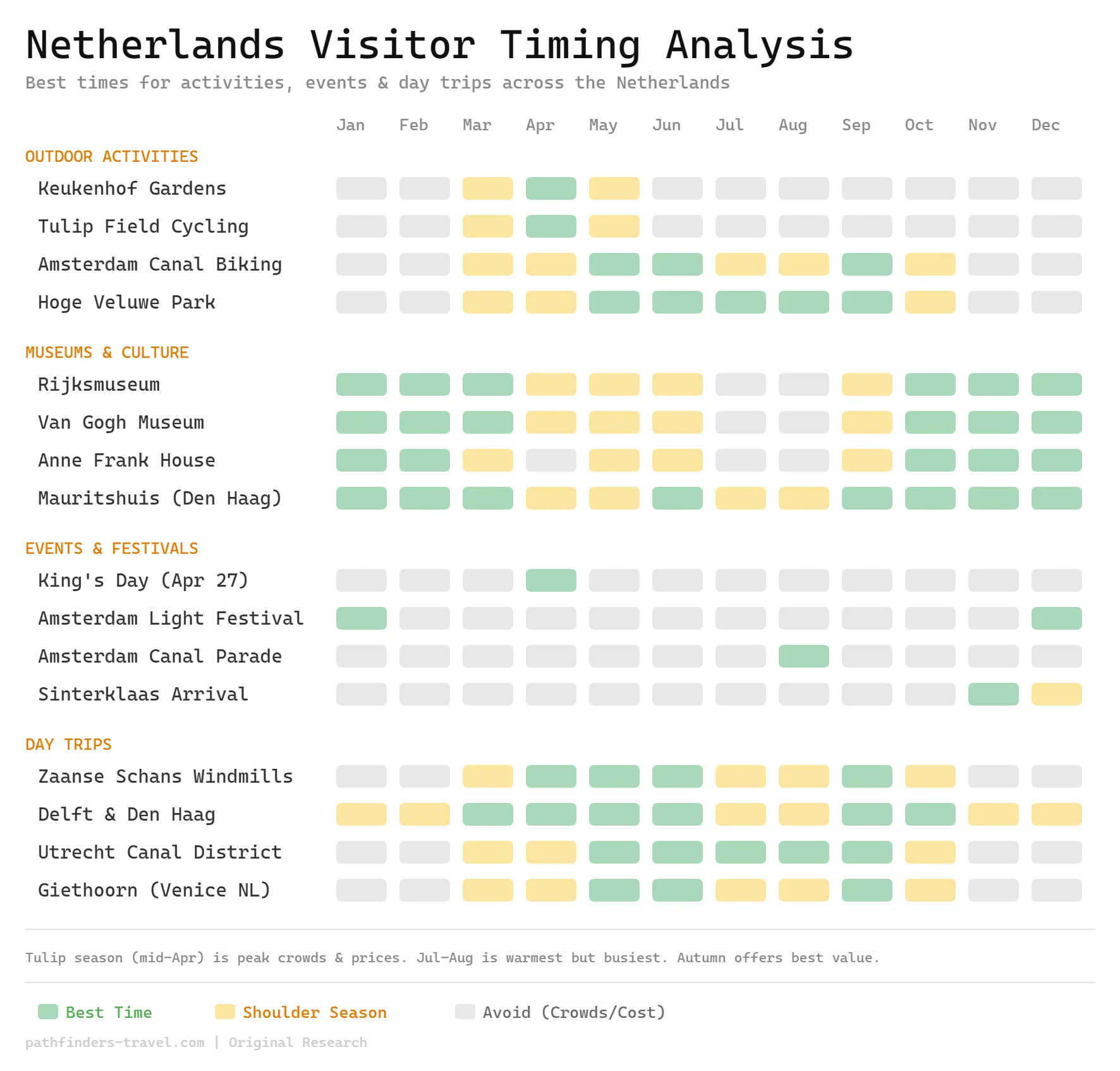
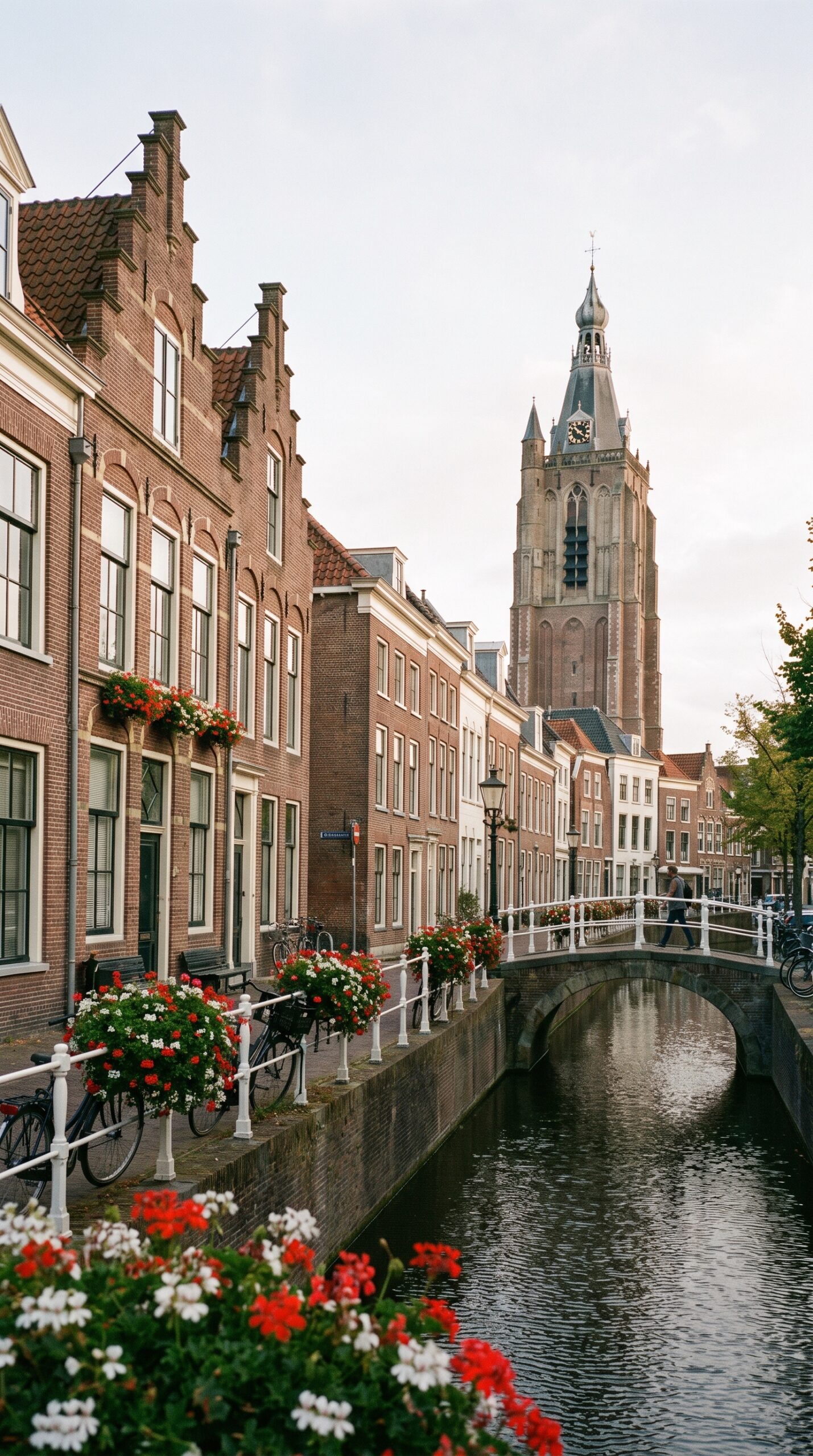
June hits the sweet spot. Long days, warm-ish weather, and crowds that haven’t peaked yet. September through November is the other smart pick, when leaves turn and prices ease. Holland.com, the official Netherlands tourism site, lays out the seasonal picture in more detail.
Want tulips? You’ll need April, roughly late March to mid-May, when the fields and the Keukenhof gardens bloom. Fair warning. That’s the busiest, priciest stretch of the year, and tickets and hotels sell out weeks ahead.
Summer brings festivals, daylight past 10 p.m., and the warmest weather, plus full trains and higher room rates in Amsterdam. The shoulder months trade flowers for quieter streets and better deals. King’s Day in late April is the wildcard, a nationwide street party that packs every city.
Here’s the honest part. Dutch weather does what it wants. Rain and wind can show up in July as easily as November, so pack a light rain layer whenever you go.
How Much a Netherlands Trip Costs
Planning Tip
A mid-range Netherlands trip runs about 120 to 200 euros per person per day, covering a hotel, trains, two museums, and meals out, with Amsterdam the priciest base.
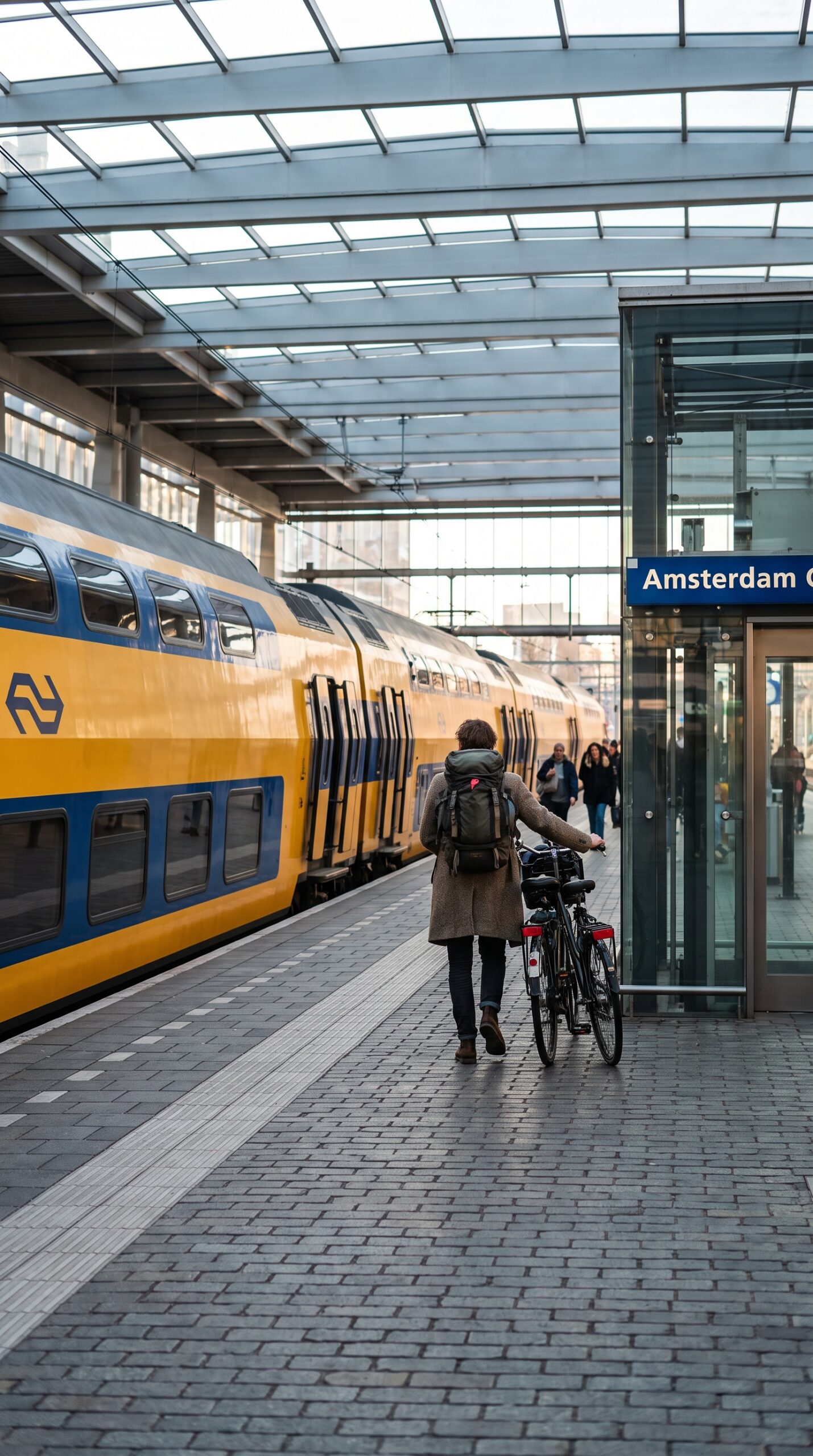
On a tight budget, you can get by on 70 to 100 euros a day with hostel dorms, supermarket lunches, and a bike. Push to the higher end, 250 euros and up, once you add private rooms in the center and sit-down dinners.
Where does the money go? Amsterdam hotels eat the biggest chunk of your Netherlands travel cost, easily 150 euros a night in season. Trains between cities run 10 to 20 euros a hop. Museum tickets sit around 20 to 25 euros each, and a casual dinner runs 20 to 35.
A few moves cut the total fast. The Netherlands Museum Pass (Museumkaart) pays off after four or five museums. In the capital, the official I amsterdam City Card bundles attractions and transit. Buy lunch at a supermarket, drink the tap water, and sleep in Rotterdam or Utrecht, where rooms cost less than Amsterdam.
The honest catch. Tulip season and summer weekends can double Amsterdam hotel prices, so book early or shift those nights to a smaller city.
Getting Around the Netherlands by Train
NS trains link every major Dutch city every 15 to 30 minutes, and one OV-chipkaart or a contactless bank card taps you onto trains, trams, and buses.

Rail travel in the Netherlands is the easy button. NS Dutch Railways runs the network, and trains show up so often you rarely check a timetable. Amsterdam to Rotterdam takes about 40 minutes. Amsterdam to Utrecht is closer to 30.
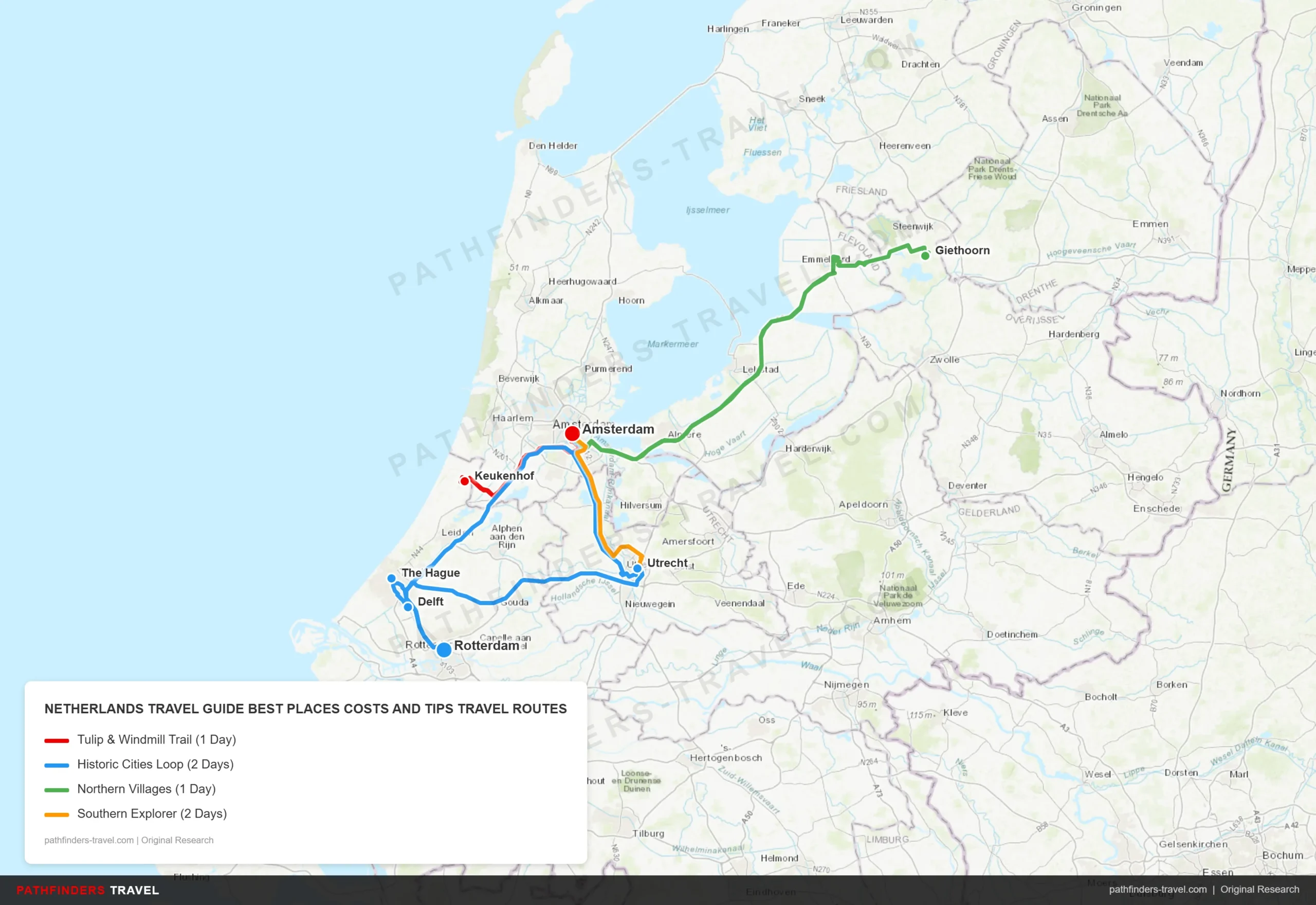
| # | Stop | Highlights | Drive Time |
|---|---|---|---|
| 1 | Amsterdam | Start early from Amsterdam Centraal; grab coffee in the Jordaan before heading south | , |
| 2 | Keukenhof | World-famous tulip gardens open late March, mid May; 7 million flowers across 32 hectares; windmill on site; book tickets well in advance | 40m from Amsterdam |
| 3 | Haarlem | Charming canal city; Grote Markt square; Frans Hals Museum; afternoon stroopwafel stop at local bakeries | 20m from Keukenhof |
| 4 | Amsterdam | Return to Amsterdam for evening canal cruise or dinner in De Pijp neighbourhood | 25m from Haarlem |
| # | Stop | Highlights | Drive Time |
|---|---|---|---|
| 1 | Amsterdam | Base for Day 1 morning; Rijksmuseum, Anne Frank House, Van Gogh Museum; canal belt UNESCO site | , |
| 2 | Utrecht | Dom Tower climb for wide views; unique wharf-level café terraces; Museum Speelklok for mechanical music | 35m from Amsterdam |
| 3 | Delft | Birthplace of Vermeer; Royal Delft factory tour for blue-and-white pottery; scenic medieval centre canals | 55m from Utrecht |
| 4 | The Hague | Netherlands seat of government; Mauritshuis museum with Vermeer’s Girl with a Pearl Earring; Madurodam miniature park | 15m from Delft |
| 5 | Rotterdam | Europe’s largest port; Cube Houses and Markthal; cutting-edge modern architecture; Erasmus Bridge views | 25m from The Hague |
| 6 | Amsterdam | Return via intercity train (1h) or drive; evening free for Leidseplein or Heineken Experience | 1h 15m from Rotterdam |
| # | Stop | Highlights | Drive Time |
|---|---|---|---|
| 1 | Amsterdam | Early departure recommended; hire a car or join an organised day tour from Amsterdam Centraal | , |
| 2 | Giethoorn | Car-free village known as the Venice of the North; rent a whisper boat to explore canals; thatched farmhouses; best visited mid-week to avoid weekend crowds | 1h 45m from Amsterdam |
| 3 | Amsterdam | Return to Amsterdam by evening; optional stop in Zwolle for dinner on the way back | 1h 45m from Giethoorn |
| # | Stop | Highlights | Drive Time |
|---|---|---|---|
| 1 | Amsterdam | Depart Amsterdam by intercity train or car heading south; pack light for an overnight | , |
| 2 | Utrecht | Midpoint stop; Dom Tower, canal wharves, and the excellent Railway Museum; good lunch spot before continuing south | 35m from Amsterdam |
| 3 | Maastricht | Netherlands’ most southern city with Roman and medieval layers; Vrijthof square; Caves of St Pietersberg; Belgian-influenced cuisine; overnight stay recommended | 1h 45m from Utrecht |
Paying is simple once you get it. Tap in at the gate, tap out when you leave, and the fare comes off automatically. A contactless bank card works, or buy an OV-chipkaart and load credit. The same tap covers trams and buses, your whole public transport in one card.
Inside a city, do as the Dutch do and rent a bike. Most stations have rentals, and flat streets make it easy to get around compact centers on two wheels.
One honest heads-up. The fare gates are strict, so make sure your card taps in and shows a green light. A failed tap can leave you stuck or fined.
Best Places to Travel in the Netherlands: The Randstad
The Randstad, the ring of cities holding Amsterdam, Rotterdam, The Hague, Utrecht, Delft, Leiden, and Gouda, packs most of the country’s first-time highlights within a hour’s train ride of each other.
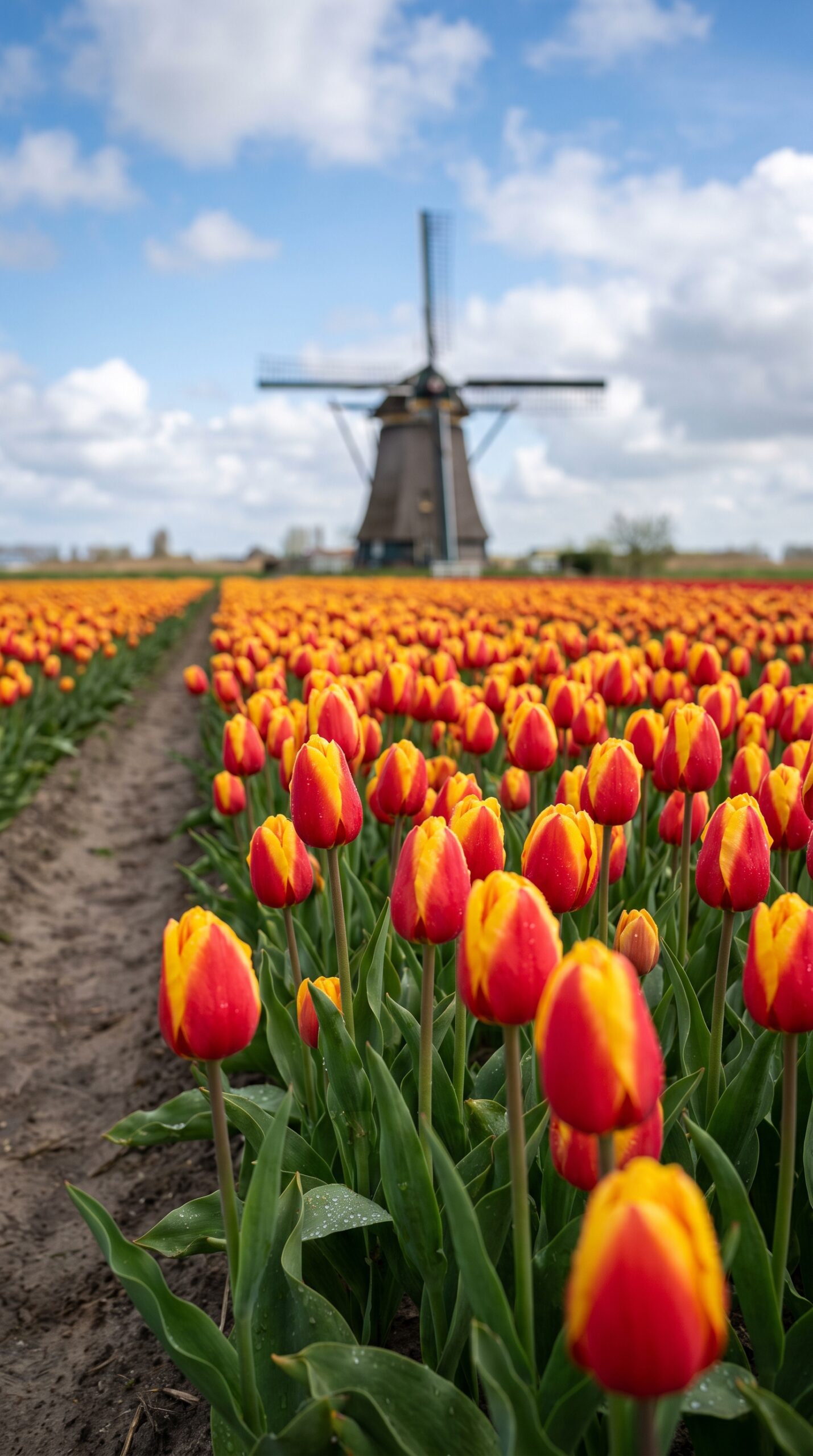
This cluster is where most trips happen. The Randstad is a horseshoe of cities in the west, and the trains between them run so often you can base in one spot and see the rest as day trips. These are the seven best places to travel in the Netherlands for a first visit.
Amsterdam
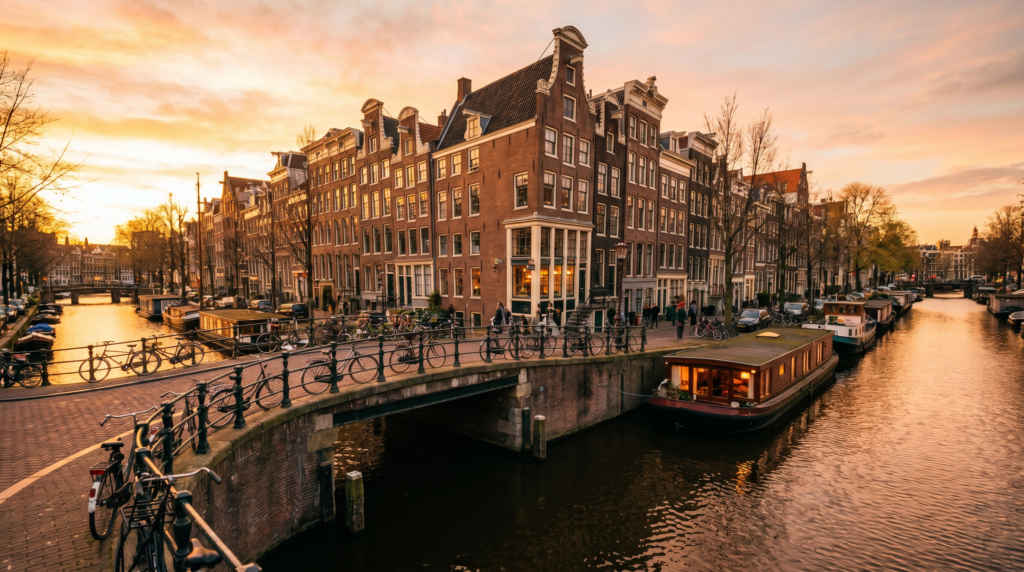
Amsterdam is where nearly everyone starts. The old center wraps around a UNESCO-listed belt of canals dug in the 1600s, best seen on foot or from a small boat. Three museums anchor a visit: the Rijksmuseum for Rembrandt and Vermeer, the Van Gogh Museum next door, and the Anne Frank House, which sells timed tickets that vanish weeks ahead. When the crowds wear you down, walk west into the Jordaan, a quieter grid of cafes, courtyards, and small shops. Book your beds and big tickets early, since the popular spots fill fast. You can plan with I amsterdam, the city’s official visitor guide.
(Full guide about Amsterdam coming soon.)
Rotterdam
Rotterdam feels nothing like Amsterdam, and that’s the point. Flattened in World War II, it rebuilt itself with architecture that leans, tilts, and glows. Start at the Cube Houses, a row of tilted yellow homes you can walk beneath and tour inside. Cross to the Markthal, a giant food arch with stalls under a painted ceiling. Walk the Erasmus Bridge for views over the busiest port in Europe. Hotel rooms here often cost less than Amsterdam, which makes it a smart base. Rotterdam’s official tourism site lists what’s on.
(Full guide about Rotterdam coming soon.)
The Hague
The Hague runs the country’s government and holds one of its best small museums. The Mauritshuis hangs Vermeer’s Girl with a Pearl Earring in a quiet 17th-century house you can see in a hour. Steps away sit the Binnenhof, the old parliament complex, and the Peace Palace, home to the International Court of Justice. When you want sand, the Scheveningen beach and pier are a short tram ride from the center. It’s an easy day trip from Amsterdam, or a calmer place to sleep.
(Full guide about The Hague coming soon.)
Utrecht
Utrecht is the one many return visitors like best. Its canals run on two levels, so old cellar warehouses at the waterline now hold cafes with tables right on the quay. Climb the Dom Tower, the tallest church tower in the country, for a long view across the flat land. The city sits dead center on the rail map, which makes it a strong base for day trips in every direction. It’s smaller and calmer than the capital, with the same canal-town looks.
(Full guide about Utrecht coming soon.)
Delft
Delft is small enough to see in half a day and pretty enough to make you stay longer. This is Vermeer’s hometown, and it’s still the source of Delftware, the blue-and-white pottery painted by hand in workshops you can visit. The Markt square lines up between two big churches, one holding the royal family’s tombs. Grab a canal-side table, watch the students bike past, and slot it in between The Hague and Rotterdam.
(Full guide about Delft coming soon.)
Leiden
Leiden is a canal city with a university at its heart and Rembrandt as its most famous son. It keeps the oldest botanical garden in the country, planted in 1590, plus a working windmill museum you can climb. In spring, most travelers pass through here on the way to the Keukenhof tulip gardens nearby. The streets are laced with quiet waterways and old courtyards called hofjes, easy to wander with no plan at all.
(Full guide about Leiden coming soon.)
Gouda
Gouda means cheese, and in summer the main square still stages a market where whole wheels change hands the old-fashioned way, sealed with a clap of the hands. The ornate 15th-century town hall stands alone in the middle of that square. Step into Sint-Janskerk to see its long run of stained-glass windows. Then buy a warm stroopwafel, two thin waffles glued with syrup, straight off the griddle.
(Full guide about Gouda coming soon.)
Windmill Villages and the Dutch Countryside
The Dutch countryside is built on windmills, fishing villages, and reclaimed land, with Zaanse Schans and the 19 UNESCO windmills of Kinderdijk the two easiest stops from Amsterdam and Rotterdam.
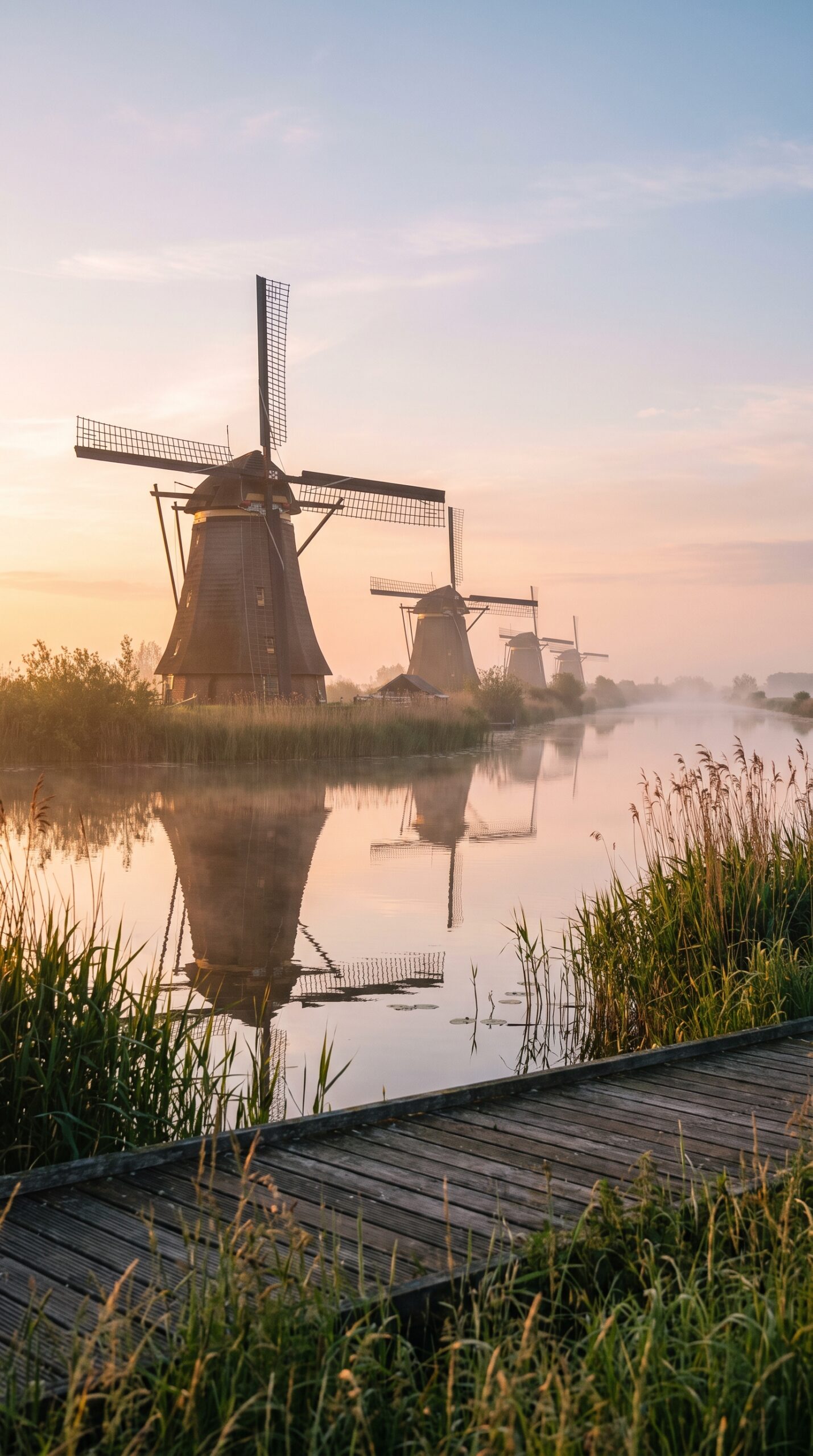
Beyond the cities, this is the Netherlands you picture. Windmills turning over green polders, wooden houses, and dikes holding back the water. You can read more on Holland.com’s guide to Dutch windmills, but here’s where to actually go.
Zaanse Schans
Zaanse Schans sits about 30 minutes north of Amsterdam, and it’s the quickest way to see working windmills up close. This open-air village lines a river with green wooden houses, a cheese farm, a clog workshop, and mills you can climb inside to watch the saws and grindstones turn. Go early. By late morning the tour buses roll in and the narrow paths get tight. A bus or train from Amsterdam gets you there in under a hour.
(Full guide about Zaanse Schans coming soon.)
Kinderdijk
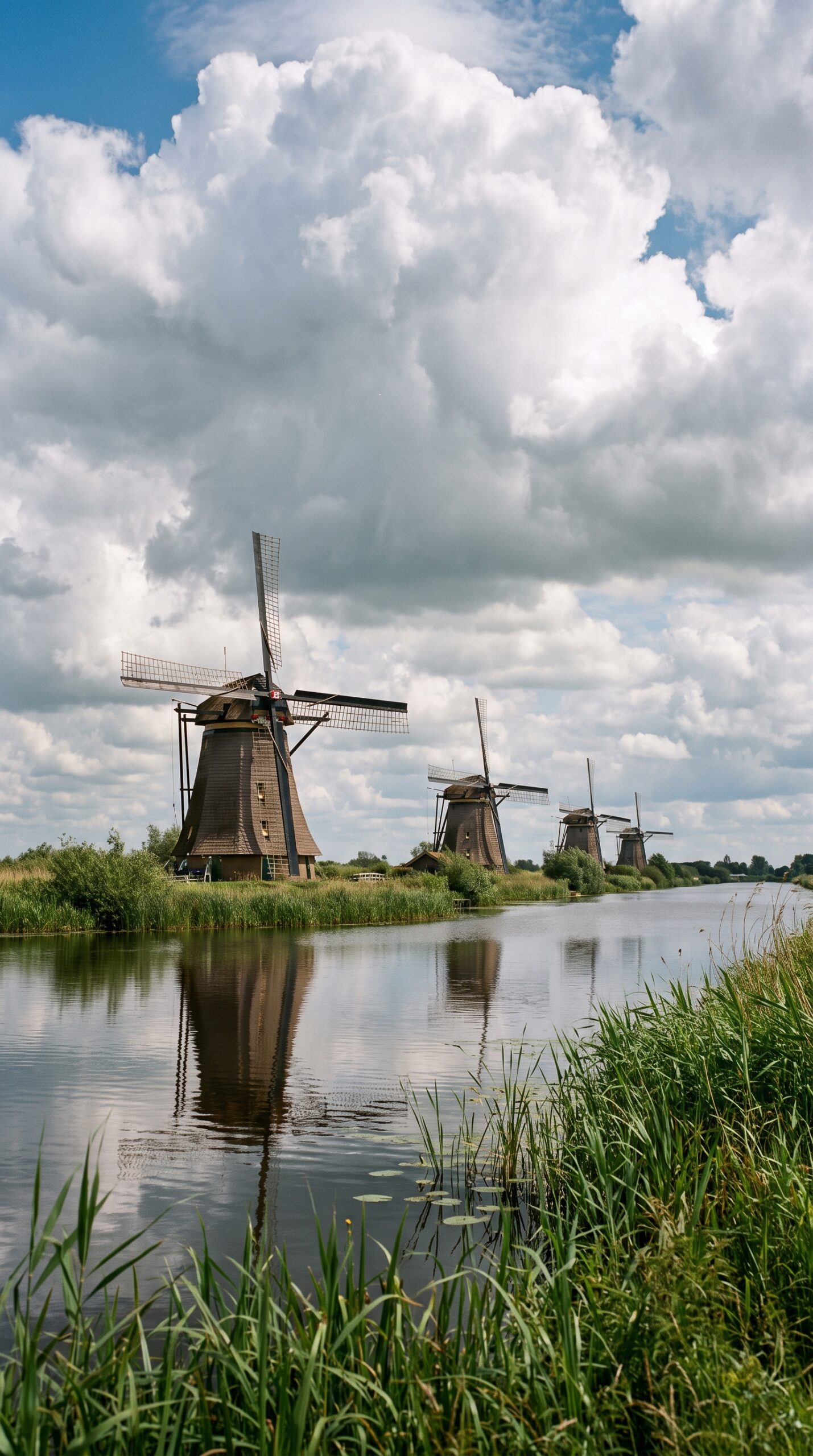
Kinderdijk is the postcard shot, 19 windmills from the 1740s lined along canals dug to pump water off the low land. It’s a UNESCO World Heritage Site, and you can walk or cycle the paths, step inside a museum mill, or ride a small boat between them. It pairs neatly with Rotterdam, a short bus or waterbus ride away. Plan tickets and boat times on Kinderdijk’s official UNESCO site.
(Full guide about Kinderdijk coming soon.)
Volendam
Volendam is an old fishing town on a former inland sea, half a hour from Amsterdam. The harbor is lined with stands selling smoked eel and fresh-fried fish, and you can pose in traditional Dutch dress for a photo, kitschy but fun. From the docks, a short ferry crosses to Marken, a tiny village of green houses built on mounds. Pair it with Edam, the cheese town just up the road.
(Full guide about Volendam coming soon.)
More Dutch Escapes Worth the Detour
These take more effort, but they pay off. The Wadden Sea Region up north is a UNESCO tidal coast where guided groups walk the mudflats at low tide, a Dutch tradition called wadlopen. (Full guide about Wadden Sea Region coming soon.) The Delta Works in Zeeland are the giant storm barriers that hold back the sea in the southwest, tourable by car or bike. (Full guide about Delta Works coming soon.) Flevoland is the country’s newest province, drained from water within living memory, with the Batavia shipyard replica and wide cycling routes. (Full guide about Flevoland coming soon.) And Amersfoort, near Utrecht, is a walled medieval town with a canal ring and far fewer crowds. (Full guide about Amersfoort coming soon.)
Netherlands Itineraries: 5, 7, and 14 Days
Seven days is the sweet spot for a Netherlands itinerary, enough to pair Amsterdam with Utrecht, Delft, The Hague, Rotterdam, and the Kinderdijk windmills at a steady pace.
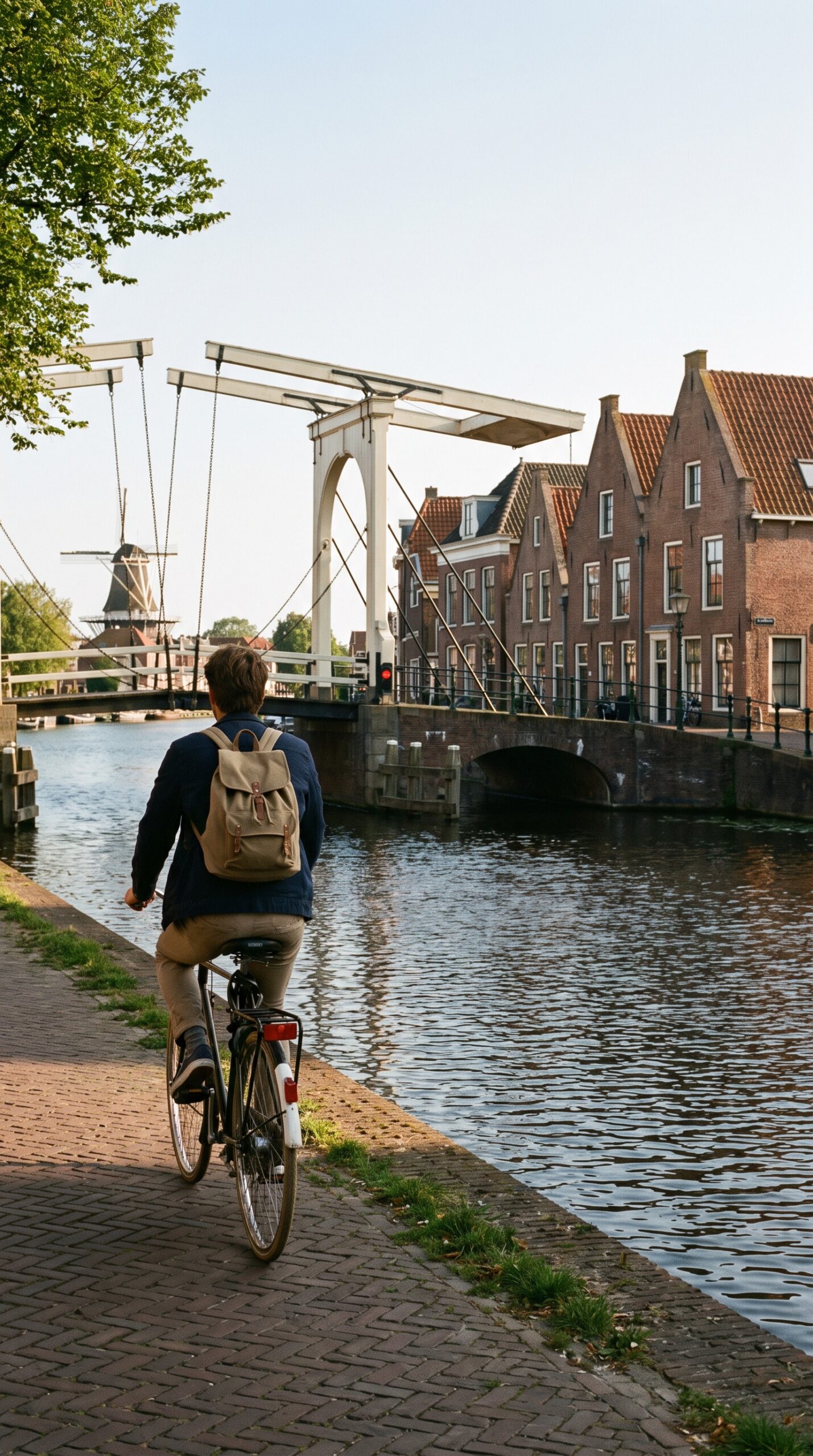
Distances here are short, so you cover a lot without long travel days. Base in one or two cities and let the trains do the work. Here are three plans by length.
5-Day Netherlands Itinerary
| Day | Base | Highlights |
|---|---|---|
| 1 to 2 | Amsterdam | Canal belt, Rijksmuseum, Anne Frank House, and the Jordaan |
| 3 | Zaanse Schans and Volendam | Windmills in the morning, fishing-village harbor after lunch |
| 4 | Utrecht | Wharf canals, the Dom Tower climb, an easy cafe day |
| 5 | Rotterdam | Cube Houses, the Markthal, and the Erasmus Bridge |
Base in Amsterdam for nights 1 to 3, then hop by train. Every ride runs under 45 minutes.
7-Day Netherlands Itinerary
| Day | Base | Highlights |
|---|---|---|
| 1 to 2 | Amsterdam | Museums, canals, and a Zaanse Schans half-day |
| 3 | Utrecht | Wharf canals and the Dom Tower |
| 4 | Delft | Delftware, the Markt, and Vermeer’s town |
| 5 | The Hague | Mauritshuis, the Binnenhof, and Scheveningen beach |
| 6 | Rotterdam and Kinderdijk | Modern architecture, then UNESCO windmills |
| 7 | Gouda or Leiden | Cheese-market town or canal-laced university city |
Split nights between Amsterdam and Rotterdam to cut daily backtracking.
14-Day Netherlands Itinerary
| Day | Base | Highlights |
|---|---|---|
| 1 to 3 | Amsterdam | Museums, canals, day trips to Zaanse Schans and Volendam |
| 4 to 5 | Utrecht and Amersfoort | Wharf canals plus a quiet walled town |
| 6 to 8 | The Hague, Delft, and Leiden | Art, pottery, and canals along the coast |
| 9 to 10 | Rotterdam and Kinderdijk | Architecture and windmills |
| 11 to 12 | Delta Works, Zeeland | Storm barriers, dunes, and seafood in the southwest |
| 13 to 14 | Wadden Sea Region | Mudflat walking and a slow northern finish |
Trains cover most of this. A rental car helps for Zeeland and the Wadden coast.
What to Pack for the Netherlands
The Netherlands uses Type C and F plugs at 230 volts, so pack a European travel adapter, a waterproof layer, and shoes that handle cobbled streets.

Start with the plug. The Netherlands runs on Type C and F sockets at 230 volts, so a cheap Netherlands travel adapter keeps your phone and camera charged. Bring a waterproof jacket too, since rain shows up in any month, plus shoes you can walk cobbles in all day.
A few more items round out the checklist:
- A reusable water bottle, since the tap water is safe to drink
- A contactless card or OV-chipkaart for trams and trains
- Layers, because Dutch weather shifts fast
Netherlands Travel FAQ
What is the best month to go to the Netherlands?
The best months are June and September through November, with mid-April for tulips. June brings long days and thinner crowds. April fills the Keukenhof gardens with color, but it’s also the busiest, priciest stretch, so book well ahead.
How many days is enough for the Netherlands?
About seven days is enough to see the Netherlands one city at a time. Start in Amsterdam with a Zaanse Schans and Keukenhof side trip, then add Utrecht, Delft, The Hague, and Rotterdam. Five days covers the highlights, and fourteen lets you reach the coast and countryside.
What is the prettiest town in Holland?
Giethoorn, a car-free village of canals and thatched cottages often called the Venice of the North, tops most lists. Volendam, Marken, and Delft are close behind. Giethoorn gets packed by midday, so go early or late to have the footbridges to yourself.
What can you not bring into the Netherlands?
Meat, dairy, and many plants from outside the EU are restricted, along with over-limit alcohol and tobacco and more than 10,000 euros in cash. Protected species and some foodstuffs must be declared. When in doubt, check Dutch customs before you fly, since the rules change.
Is Amsterdam Safe for Female Tourists?
Yes, Amsterdam is safe for female tourists, day or night, with normal big-city caution. Watch for pickpockets near Centraal Station and on crowded trams. The center stays busy and well lit, and trams, trains, and taxis run late if you’re out.