
SPAIN TRAVEL GUIDE
Overview
Spain is where Europe runs out of land and Africa comes into view. In a single trip you can walk a Roman aqueduct in the morning, stand inside a Moorish palace by afternoon, and watch the sun drop into the Atlantic from a beach where two continents face each other across nine miles of water. It is one of the most geographically varied countries in Europe: green Atlantic coastline in the north, a high dry plateau through the middle, Mediterranean shore in the east, and subtropical volcanic islands off the coast of Africa.
We love travelling in Spain because the distances are manageable and the trains are excellent. The AVE high-speed network links Madrid to Seville, Córdoba, Málaga, Valencia and Barcelona in two to three hours, which means you can build a serious itinerary without spending the trip behind a steering wheel. Madrid makes a natural starting point: it sits in the middle of the country, has the best rail connections in Spain, and holds three of Europe’s great art museums within a ten-minute walk of each other.
Andalusia in the south is the Spain most people picture: the Alhambra above Granada, the Mezquita in Córdoba, Seville’s old quarter, and the whitewashed pueblos blancos strung along the mountains behind the coast. Head north instead and the country changes completely. Bilbao and San Sebastián anchor the Basque coast and its pintxos bars, the Picos de Europa put alpine hiking two hours from the sea, and Santiago de Compostela ends the Camino in a rain-washed granite square.
Then there are the islands. Mallorca, Menorca and Ibiza sit a short ferry or flight from the mainland with completely different personalities, while the Canary Islands — Tenerife, Gran Canaria, Lanzarote — lie closer to Morocco than to Madrid and stay warm all winter. Add the Roman ruins of Extremadura and the wind-scoured Atlantic beaches of Tarifa, and Spain covers more ground than almost anywhere else in Europe.
Bookmark this Spain travel guide and keep checking back for more of our best Spain travel tips and hidden gems!
Country Snapshot
Safety
Spain is one of the safest countries in Europe, with low rates of violent crime and a strong emergency network — dial 112 anywhere in the country. The realistic risk for travellers is petty theft: pickpocketing and bag-snatching on Barcelona’s Las Ramblas, around Madrid’s Puerta del Sol, in Seville’s old quarter and on busy metro lines. Keep your phone off café tables, use a zipped bag in crowds, and never leave belongings unattended on a beach. Summer heat is the other genuine hazard: inland Andalusia regularly passes 40°C in July and August, so plan sightseeing for early morning and evening.
Spanish is spoken everywhere, and Catalan, Galician and Basque are co-official in their own regions. English is widely understood in tourist areas but far less so in small towns and the countryside, so a handful of phrases — “hola”, “por favor”, “gracias”, “la cuenta, por favor” — goes a long way.
Accommodation
Spain has one of the deepest accommodation markets in Europe. Madrid, Barcelona, Seville and Valencia run the full range from design hostels to five-star hotels, while smaller cities like Granada, Córdoba and San Sebastián are full of restored townhouses and family-run guesthouses. For something distinctly Spanish, look at the state-run paradores — castles, monasteries and convents converted into hotels, often in towns with no other good option. Rural casas rurales work well in the Picos de Europa and Extremadura, and the islands are dominated by apartments and resorts. You can search for the best accommodation deals in Spain on Booking.com or Hotels.com.
Budget
Spain is one of the better-value countries in Western Europe. Hostel dorms run roughly €20-35 per night, budget hotels and guesthouses €60-100, and mid-range city hotels €100-160 — with Barcelona, Madrid, San Sebastián and the islands in peak summer sitting at the top of those ranges. The menú del día, a fixed-price three-course lunch with a drink, is the best food deal in the country at about €12-18. Casual dinners run €20-35 per person and a caña of beer or a coffee is usually €1.50-3. High-speed rail booked weeks ahead costs a fraction of the walk-up fare, and long-distance buses are cheaper still.
Best Time to Visit
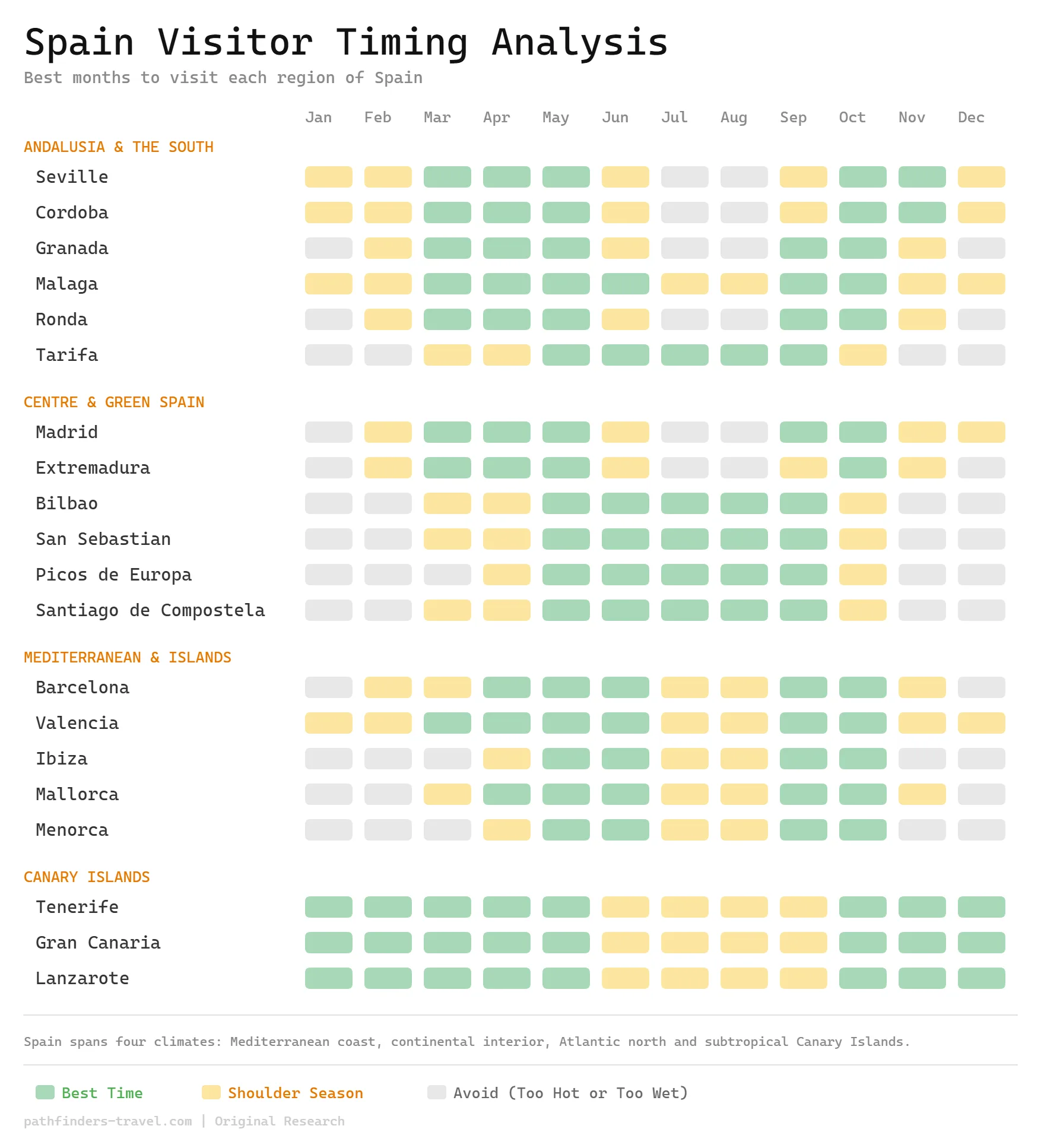
Spain has no single best season, because the country covers four climates at once. Spring (April to June) and autumn (September to October) are the sweet spot for most of the mainland — warm days, manageable crowds, no inland heat. Andalusia is at its best from March to May and October to November; July and August in Seville and Córdoba are genuinely punishing. The Atlantic north — Bilbao, San Sebastián, the Picos de Europa, Galicia — is the exception and peaks in July and August, when the rest of the country is too hot. The Balearics run May to October, and the Canary Islands are a year-round destination that comes into its own from November to March. The chart below breaks down the optimal timing for each destination.
Places to Visit
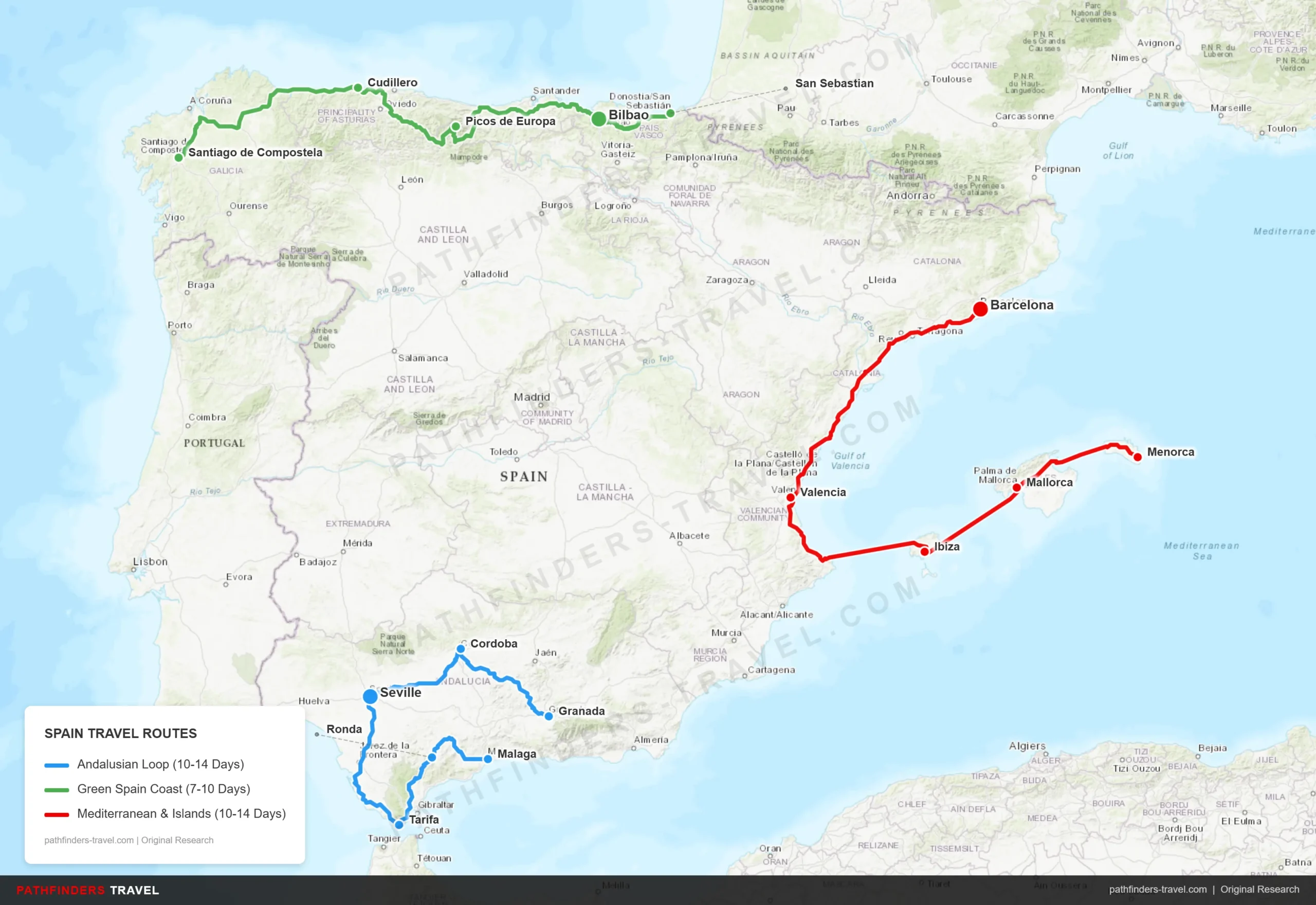
Spain’s regions are distinct enough that most travellers pick one or two per trip rather than trying to cross the whole country. The Andalusian loop from Málaga through Ronda, Tarifa, Seville, Córdoba and Granada is the classic first trip, combining Moorish architecture, white villages and the Strait of Gibraltar. Green Spain along the north coast — Bilbao, San Sebastián, the Picos de Europa, Cudillero and Santiago de Compostela — trades heat and crowds for mountains, seafood and rain-fed landscapes. The Mediterranean and island route from Barcelona down through Valencia to Ibiza, Mallorca and Menorca is built around ferries and beaches. Below are our recommended travel routes with key stops and travel times.
| # | Stop | Highlights | Travel Time |
|---|---|---|---|
| 1 | Málaga | Alcazaba, Picasso Museum, old town tapas | — |
| 2 | Ronda | Puente Nuevo, El Tajo gorge, clifftop old town | 1h 45m |
| 3 | Setenil de las Bodegas | Streets built beneath overhanging rock | 30m |
| 4 | Tarifa | Two continents in one view, kitesurfing, Atlantic beaches | 2h 15m |
| 5 | Seville | Real Alcázar, cathedral and Giralda, Triana | 2h 30m |
| 6 | Córdoba | Mezquita-Catedral, flower-filled patios, Roman bridge | 1h 45m |
| 7 | Granada | Alhambra, Albaicín, Sierra Nevada on the skyline | 2h 15m |
| # | Stop | Highlights | Travel Time |
|---|---|---|---|
| 1 | Bilbao | Guggenheim, Casco Viejo, pintxos bars | — |
| 2 | San Sebastián | La Concha beach, Monte Igueldo, Basque food scene | 1h 15m |
| 3 | Picos de Europa | Fuente Dé cable car, Cares Gorge, alpine hiking | 3h 15m |
| 4 | Cudillero | Amphitheatre fishing village, Asturian cliffs | 2h |
| 5 | Santiago de Compostela | Cathedral, granite old town, end of the Camino | 3h 30m |
| # | Stop | Highlights | Travel Time |
|---|---|---|---|
| 1 | Barcelona | Sagrada Família, Gothic Quarter, Park Güell | — |
| 2 | Valencia | City of Arts and Sciences, Turia gardens, paella | 3h 30m by AVE |
| 3 | Ibiza | Dalt Vila, north-coast coves, sunset points | Ferry 5h |
| 4 | Mallorca | Serra de Tramuntana, Palma, hidden calas | Ferry 4h |
| 5 | Menorca | Camí de Cavalls, quiet beaches, Ciutadella | Ferry 1h 30m |
Destination Difficulty
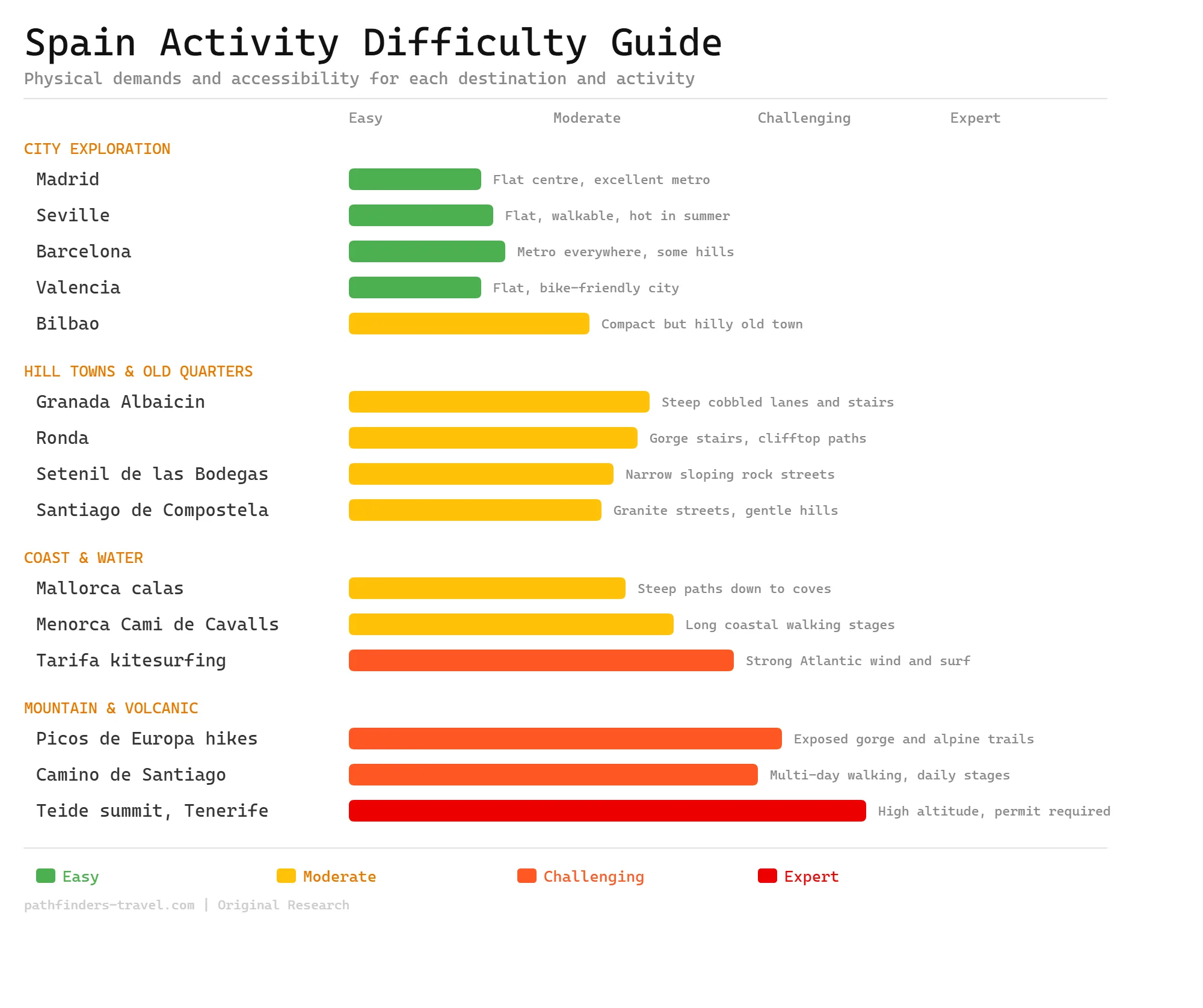
Spain is one of the easier European countries to travel in, but the range is wider than it first looks. Madrid, Seville, Valencia and Barcelona are flat, walkable and fully served by metro and high-speed rail. Granada, Ronda, Setenil de las Bodegas and the white villages involve steep cobbled streets and long flights of stairs that catch people out. The Picos de Europa and the Camino de Santiago demand real hiking fitness, and Tarifa’s wind-driven beaches and the volcanic trails of Tenerife and Lanzarote sit somewhere in between. The chart below rates each destination and activity so you can plan according to your comfort level.
Transport
Getting around Spain is easiest by train. Renfe’s AVE high-speed network connects Madrid to Seville, Córdoba, Málaga, Valencia and Barcelona at up to 300 km/h, and advance tickets cost far less than buying on the day. ALSA runs a comprehensive long-distance bus network that reaches the towns the trains miss, usually for about half the price. A rental car only really pays off in Andalusia’s white villages, the Picos de Europa and rural Extremadura, where public transport thins out — bear in mind that most historic centres are restricted-traffic zones with automatic fines. The islands are reached by short flights or by ferry from Barcelona, Valencia and Dénia. In cities, Google Maps and Citymapper both handle Spanish public transport well.
Best Activities
The Best Activities & Tours That I Recommend
Blog Posts
No post found!