ITALY TRAVEL GUIDE
Overview
Italy is a mix of ancient ruins, Renaissance cities and serious mountains, often within an hour of each other. You can stand in the Colosseum in the morning and eat dinner in a hill town where little has changed in centuries. Fast trains connect Milan, Florence, Rome and Naples, so the classic route works fine without a car, while the Dolomites, the lakes and the far south reward anyone who rents one.
Getting around Italy is straightforward. High-speed trains run between the major cities at up to 300 km/h, regional trains fill the gaps, and ferries link the islands. Rome is the natural starting point, with two thousand years of ruins stacked on top of each other and an airport connected to most of Europe. Give it three days minimum.
Florence holds the Renaissance within walking distance, the Uffizi, the Duomo and Michelangelo’s David all inside a centre you can cross in twenty minutes. Venice sits out on its lagoon and rewards anyone who stays the night, when the day trippers leave and the alleys go quiet. South of Naples the Amalfi Coast delivers the cliffs and pastel villages everyone pictures, and Cinque Terre does the same on the Ligurian side.
The north feels like a separate country. The Dolomites rise into pale limestone towers above alpine meadows, and the lakes at Garda, Como and Orta sit beneath mountains barely an hour from Milan. Head south instead and you reach Matera’s cave dwellings, the cone-roofed trulli of Puglia and Greek temples in Sicily, all with a fraction of the crowds and noticeably lower prices.
Bookmark this Italy travel guide and keep checking back for more Italy travel tips and quieter corners worth the detour.
Country Snapshot
Safety
Italy is a safe country to travel in, and violent crime against visitors is rare. The realistic risk is pickpocketing in crowded places: Rome’s Termini station and the 64 bus, the Venice vaporetto, and the streets around Milan’s Duomo. Keep your phone and wallet in a front pocket or a zipped bag, and be wary of anyone crowding you on public transport. Tap water is safe to drink almost everywhere, and the emergency number is 112.
Italian is the official language. English is widely spoken in hotels, larger restaurants and tourist areas, much less so in small towns and the deep south. A few words go a long way: buongiorno for hello, per favore for please, grazie for thanks. Menus outside the tourist centres are often Italian only.
Accommodation
Italy has accommodation at every level, from family run pensioni and agriturismi on working farms to converted palazzi and design hotels. Rome, Florence and Venice have the widest choice and the highest prices, so book those months ahead for spring and summer. Agriturismi in Tuscany, Umbria and Puglia are the best value in the country, usually with breakfast and often dinner made from what the farm grows. You can search for accommodation deals in Italy on Booking.com or Hotels.com.
Budget
Italy runs cheaper than northern Europe, but the famous cities are not cheap. Hostel dorms start around 25 to 40 euros a night, and a simple double in a three star hotel runs 80 to 150 euros, more in Venice and Florence at peak season. Pizza or pasta at a neighbourhood trattoria is 8 to 14 euros, a coffee standing at the bar is about 1.20 to 1.50 euros, and the same coffee at a table can cost three times that. Most cities add a tourist tax of 1 to 7 euros per person per night, paid at the hotel. The south is noticeably cheaper than the north.
Best Time to Visit
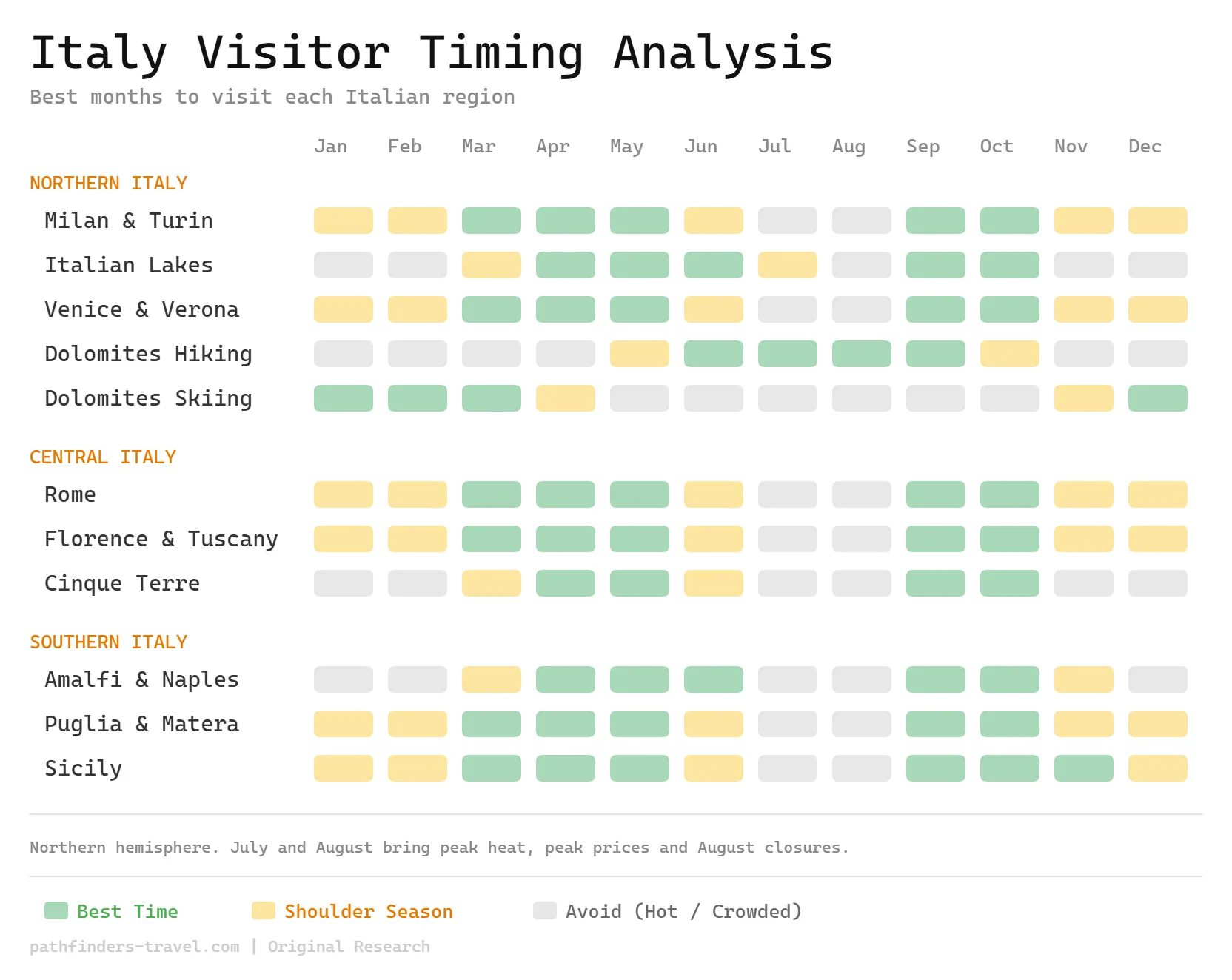
Italy works nearly year round, but the sweet spots are April to June and September to October, when the weather is warm and the crowds thin out. July and August bring heat above 35 degrees Celsius in the centre and south, peak prices, and many family run restaurants closed for the August holidays. Winter suits the cities and the ski season in the Dolomites, though coastal resorts and much of Cinque Terre wind down. The chart below breaks down the timing for each region.
Places to Visit
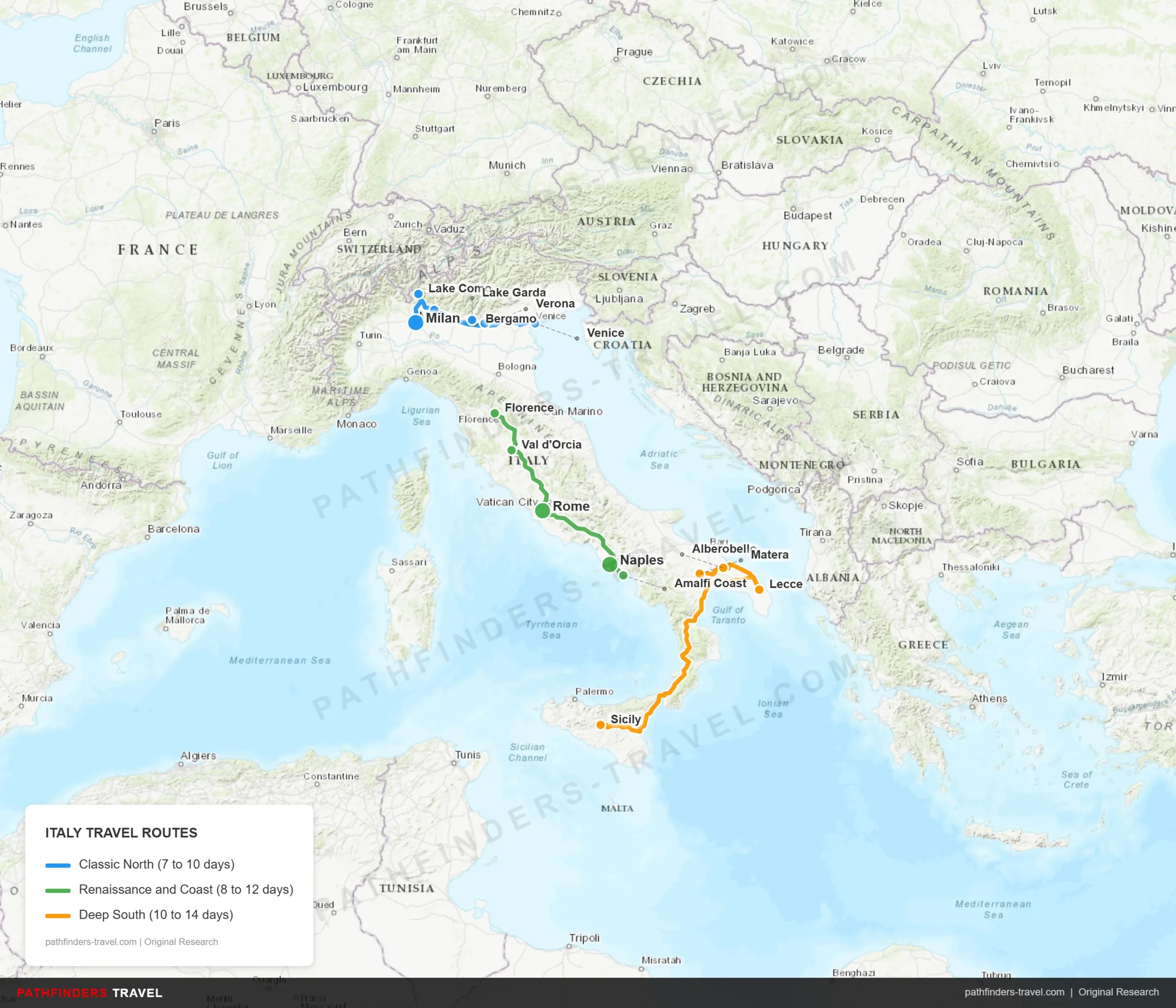
Italy is long, so most trips cover one or two stretches rather than the whole country. The Classic North links Milan, the lakes, Verona and Venice, with fast trains between them. The Renaissance and Coast route runs Florence to Val d’Orcia, then Rome and down to the Amalfi Coast. For fewer crowds, the Deep South takes in Matera, the trulli towns of Puglia and the temples of Sicily. Below are the recommended routes with key stops and drive times.
| # | Stop | Highlights | Drive Time |
|---|---|---|---|
| 1 | Milan | Duomo rooftop, The Last Supper, Navigli aperitivo | Start |
| 2 | Lake Como | Bellagio, Varenna, lakeside villa gardens | 1h 15m |
| 3 | Bergamo | Città Alta walls, funicular, old town dining | 1h 30m |
| 4 | Verona | Roman arena, Piazza delle Erbe, summer opera | 1h 30m |
| 5 | Lake Garda | Sirmione thermal spa, Malcesine castle | 40m |
| 6 | Venice | St Mark’s, Doge’s Palace, Burano day trip | 2h |
| # | Stop | Highlights | Drive Time |
|---|---|---|---|
| 1 | Florence | Uffizi, Duomo dome climb, Oltrarno workshops | Start |
| 2 | Val d’Orcia | Pienza, Montalcino, cypress-lined roads | 1h 30m |
| 3 | Rome | Colosseum, Vatican Museums, Trevi Fountain | 2h 30m |
| 4 | Naples | Historic centre, pizza, Pompeii nearby | 2h 15m |
| 5 | Amalfi Coast | Positano, Ravello gardens, the coast road | 1h 30m |
| # | Stop | Highlights | Drive Time |
|---|---|---|---|
| 1 | Matera | Sassi cave dwellings, rock-cut churches | Start |
| 2 | Alberobello | Trulli houses, Valle d’Itria | 1h 15m |
| 3 | Ostuni | White hill town, Adriatic beaches | 45m |
| 4 | Lecce | Baroque centre, papier-mâché workshops | 1h |
| 5 | Sicily | Taormina, Agrigento temples, Ortigia | Ferry + 4h |
Destination Difficulty
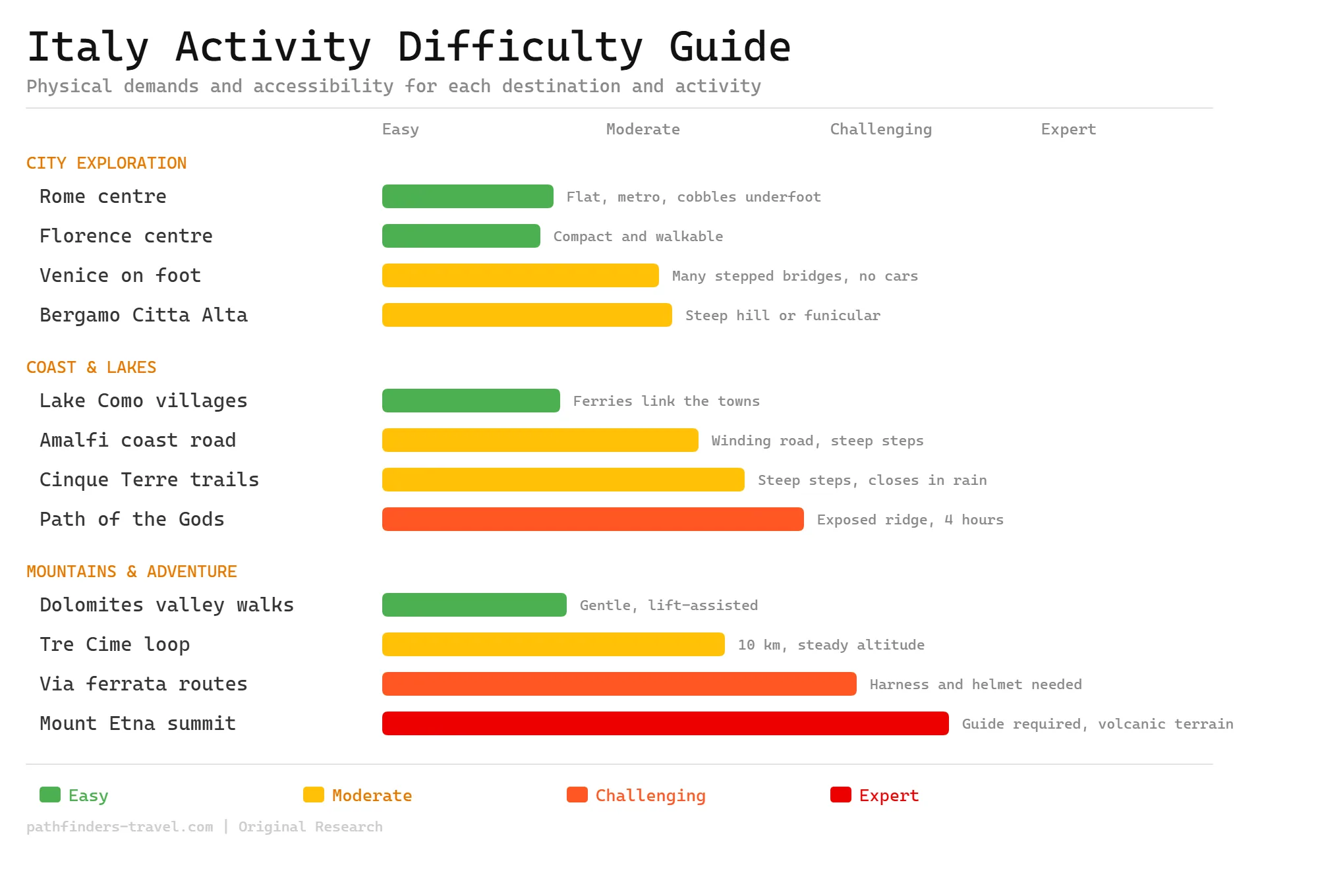
Italy ranges from flat city sightseeing to serious alpine hiking. Rome, Florence and Milan are walkable, though centuries-old cobbles and long museum queues make good shoes worth packing. Venice has no cars but plenty of stepped bridges, which makes it hard going with heavy luggage or limited mobility. The Cinque Terre coastal paths involve steep steps and close after heavy rain. The Dolomites hold everything from gentle valley walks to exposed via ferrata routes that need proper equipment and experience. The chart below rates each type of destination so you can plan to your comfort level.
Transport
Trains are the backbone of travel in Italy. Trenitalia and Italo run high-speed services between Milan, Bologna, Florence, Rome and Naples, often quicker than flying once you count airport time, and much cheaper booked weeks ahead. Regional trains reach the smaller towns but run slower and are frequently late. A car earns its keep in Tuscany, Puglia, Sicily and the Dolomites, but watch for ZTL zones in historic centres, where driving in without a permit triggers an automatic camera fine. Ferries connect Sicily, Sardinia and the smaller islands, and city transport is cheap, with a Rome metro ticket around 1.50 euros.
Best Activities
The Best Activities & Tours That I Recommend
Blog Posts