
JAPAN TRAVEL GUIDE
Overview
Japan is a mesmerizing blend of ancient tradition and futuristic innovation. You can watch the neon-lit crowds surge across Shibuya Crossing in the morning, stand before the incense clouds of a 1,400-year-old temple by afternoon, and soak in a mountain onsen with a view of Mount Fuji by nightfall. From the shrine-dotted forests of Kyoto to the coral reefs of Okinawa, Japan packs an astonishing range of experiences into one famously safe, clean, and efficient country.
We absolutely love traveling in Japan. The Shinkansen bullet train network connects nearly every corner of the country, the locals are unfailingly polite and helpful, and the infrastructure makes exploring everything from mega-cities to remote islands remarkably easy. Tokyo is the natural starting point – perfect for experiencing Shibuya Crossing, the historic Sensoji Temple in Asakusa, and day trips to the seaside temples of Kamakura or the hot-spring resort town of Hakone.
Kyoto serves as the cultural heart of the nation with over 1,600 temples, the vermilion torii tunnels of Fushimi Inari Shrine, and the towering bamboo groves of Arashiyama. Nearby, Nara’s friendly bowing deer roam around the giant bronze Buddha of Todaiji, while Osaka delivers Japan’s best street food along the canals of Dotonbori. Further west, Hiroshima’s moving Peace Memorial and the floating torii gate of Itsukushima Shrine on Miyajima Island make an unforgettable extension.
From the powder snow and ramen alleys of Sapporo in Hokkaido to the turquoise water and coral reefs of Kabira Bay on Ishigaki Island, Japan is a true year-round destination. Whether you’re chasing cherry blossoms in spring, climbing Mount Fuji in summer, photographing fiery autumn foliage in Yamanashi, or skiing legendary Hokkaido powder in winter, Japan delivers experiences that will leave you speechless.
Bookmark this Japan travel guide and keep checking back for more of our best Japan travel tips and hidden gems!
Country Snapshot
Safety
Japan is consistently ranked among the safest countries in the world, with extremely low crime rates and excellent emergency services. The main safety considerations are natural: earthquakes are common but buildings are engineered for them, and typhoon season runs roughly from June to October, mainly affecting Okinawa and the Pacific coast. Follow local guidance during storms, heed volcanic-activity notices around areas like Hakone, and check conditions before climbing Mount Fuji outside the official July–September season.
Japanese is the national language, and while English signage is widespread in cities and on trains, everyday English is less common than many visitors expect. Learning a few basic phrases like “konnichiwa” (hello) and “arigatou gozaimasu” (thank you) goes a long way and is warmly appreciated by locals.
Accommodation
As a tourist in Japan, you’ll find superb accommodation at every budget, from capsule hotels and hostels to luxury high-rises. Tokyo, Kyoto, and Osaka offer the widest selection, but the most memorable stays are often traditional: a ryokan inn with kaiseki dinner and hot-spring baths in Hakone, a restored machiya townhouse in Kyoto, or a beachfront resort on Ishigaki Island near Kabira Bay. You can search for the best accommodation deals in Japan on Booking.com or Hotels.com.
Budget
Japan is more affordable than its reputation suggests. Hostels and capsule hotels start around ¥3,000–5,000 ($20–34 USD) per night, while budget business hotels run about ¥8,000–15,000 ($55–100 USD). A filling meal costs ¥800–1,500 ($6–10 USD) at ramen shops, conveyor-belt sushi, and convenience stores, while mid-range restaurants charge ¥2,000–4,000 ($14–27 USD). A 7-day Japan Rail Pass or regional rail passes can dramatically cut long-distance transport costs if you plan to cover several cities.
Best Time to Visit
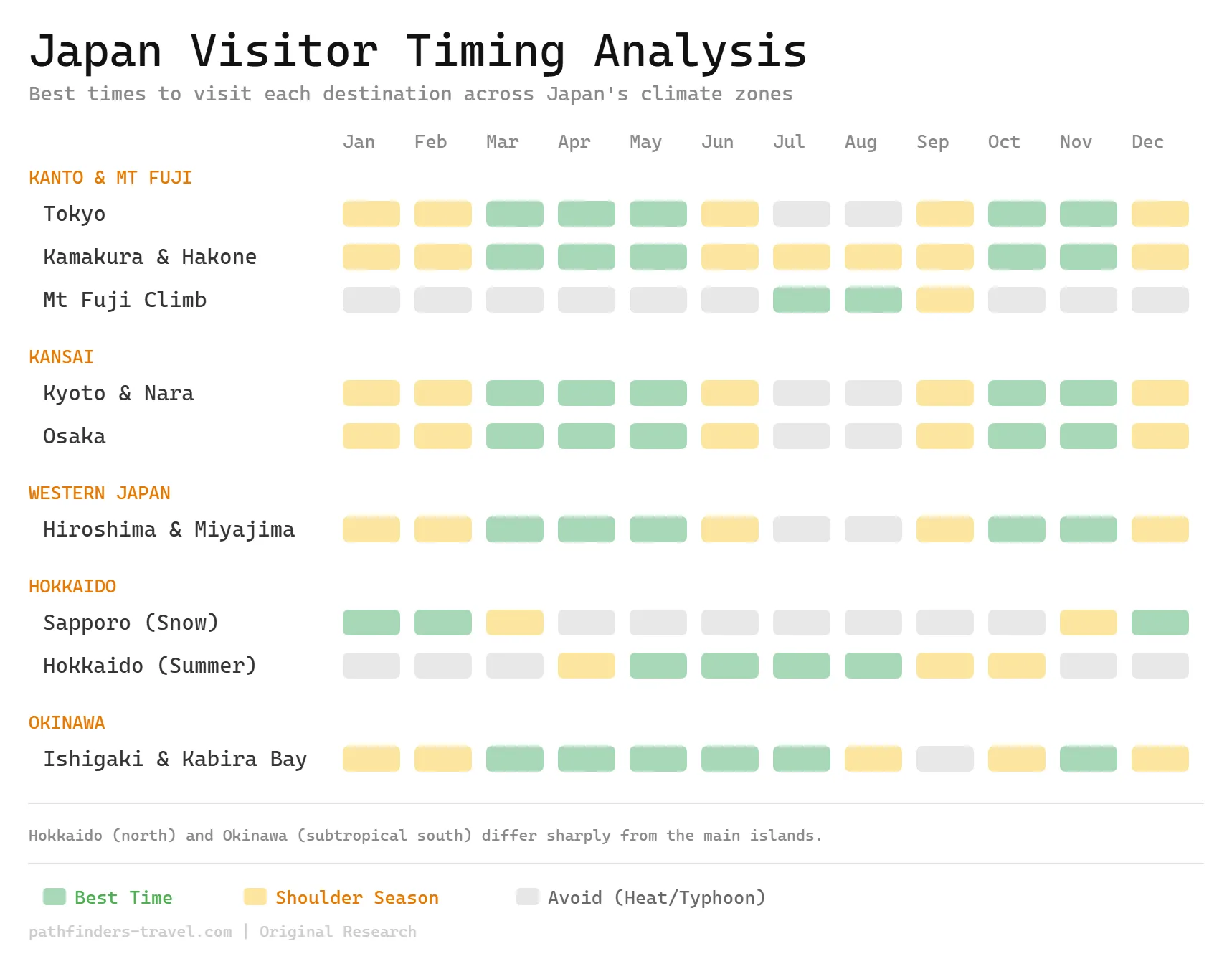
Japan stretches from subarctic Hokkaido to subtropical Okinawa, so the best time to visit depends on the region. Spring (late March to May) brings cherry blossoms and mild weather to Tokyo, Kyoto, and Osaka, while autumn (October to November) paints the temples and mountains in brilliant red and gold. Summer is hot and humid on the main islands but ideal for Hokkaido’s lavender fields and for climbing Mount Fuji (July to early September). Winter means world-class powder snow around Sapporo, while Okinawa’s Ishigaki and Kabira Bay stay warm enough for beach and reef trips most of the year. The chart below breaks down the optimal timing for each destination.
Places to Visit
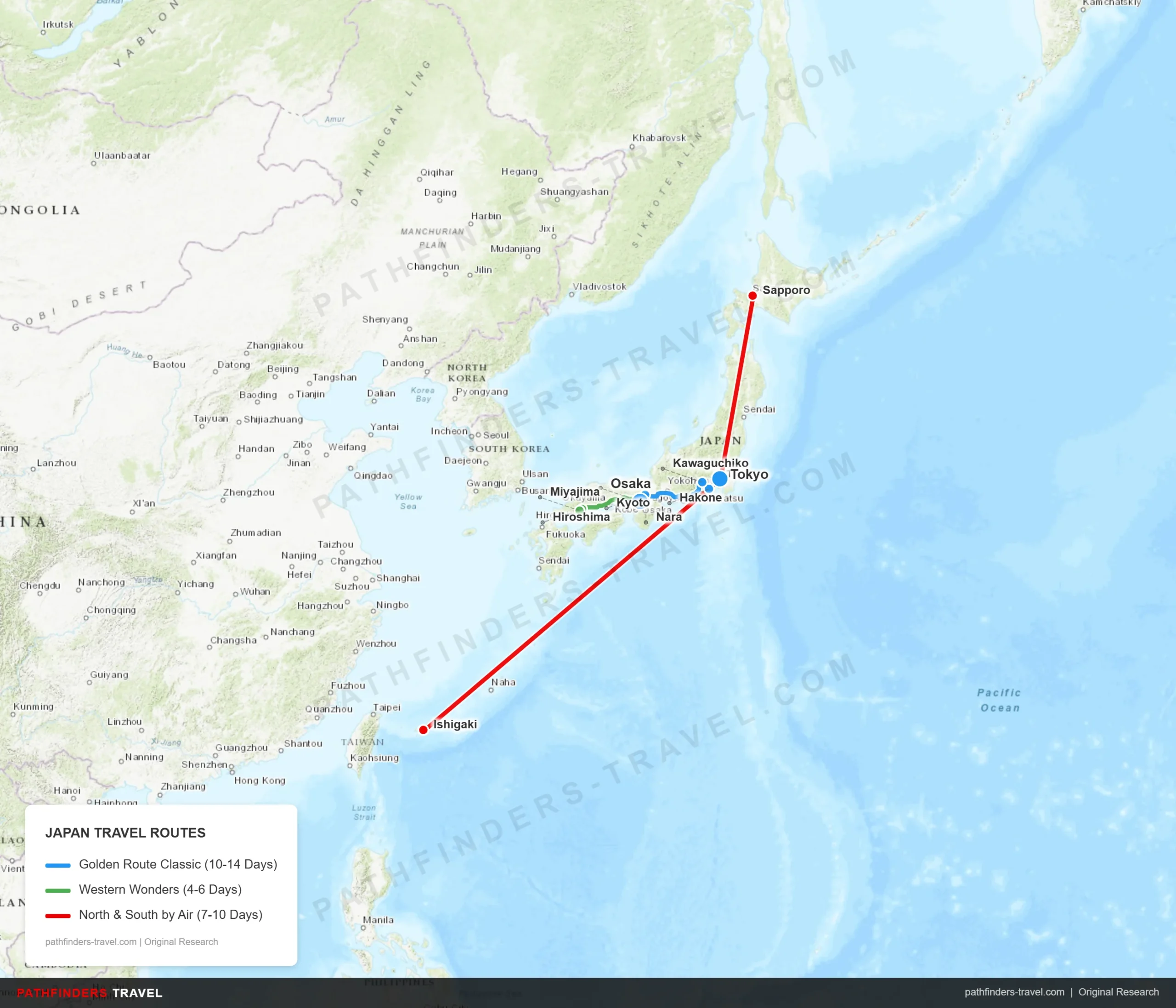
Japan’s superb rail network makes multi-city trips effortless. The Golden Route from Tokyo through Hakone and Mount Fuji to Kyoto, Nara, and Osaka is the classic first-timer itinerary, combining neon cityscapes with temples, shrines, and onsen towns. The Western Wonders route extends from Osaka to Hiroshima and the floating torii gate of Miyajima. For something completely different, head north to Hokkaido for Sapporo’s food scene and volcanic hot springs, or fly south to Ishigaki Island for Kabira Bay and some of Japan’s best coral reef diving. Below are our recommended travel routes with key stops and travel times.
| # | Stop | Highlights | Travel Time |
|---|---|---|---|
| 1 | Tokyo | Shibuya Crossing, Sensoji Temple, Meiji Shrine | — |
| 2 | Kamakura | Great Buddha, Hasedera Temple, coastal walks | 1h |
| 3 | Hakone | Lake Ashi, onsen ryokan, Hakone Shrine torii | 1h 30m |
| 4 | Kawaguchiko (Yamanashi) | Mount Fuji views, Chureito Pagoda | 1h 30m |
| 5 | Kyoto | Fushimi Inari Shrine, Arashiyama bamboo grove, Gion | 2h 30m |
| 6 | Nara | Todaiji Temple, bowing deer of Nara Park | 45m |
| 7 | Osaka | Dotonbori street food, Osaka Castle | 45m |
| # | Stop | Highlights | Travel Time |
|---|---|---|---|
| 1 | Osaka | Dotonbori, Umeda Sky Building, Kuromon Market | — |
| 2 | Himeji | Himeji Castle, Japan’s finest original fortress | 1h |
| 3 | Hiroshima | Peace Memorial Park, Hiroshima-style okonomiyaki | 1h 30m |
| 4 | Miyajima | Itsukushima Shrine floating torii, Mount Misen | 1h |
| # | Stop | Highlights | Travel Time |
|---|---|---|---|
| 1 | Sapporo | Odori Park, ramen alley, Sapporo Beer Museum | — |
| 2 | Otaru | Canal district, glassworks, fresh sushi | 45m |
| 3 | Noboribetsu | Hell Valley, Hokkaido’s most famous onsen | 1h 30m |
| 4 | Ishigaki Island | Kabira Bay, coral reef diving, Yaeyama Islands | Flight via Tokyo/Osaka |
Destination Difficulty
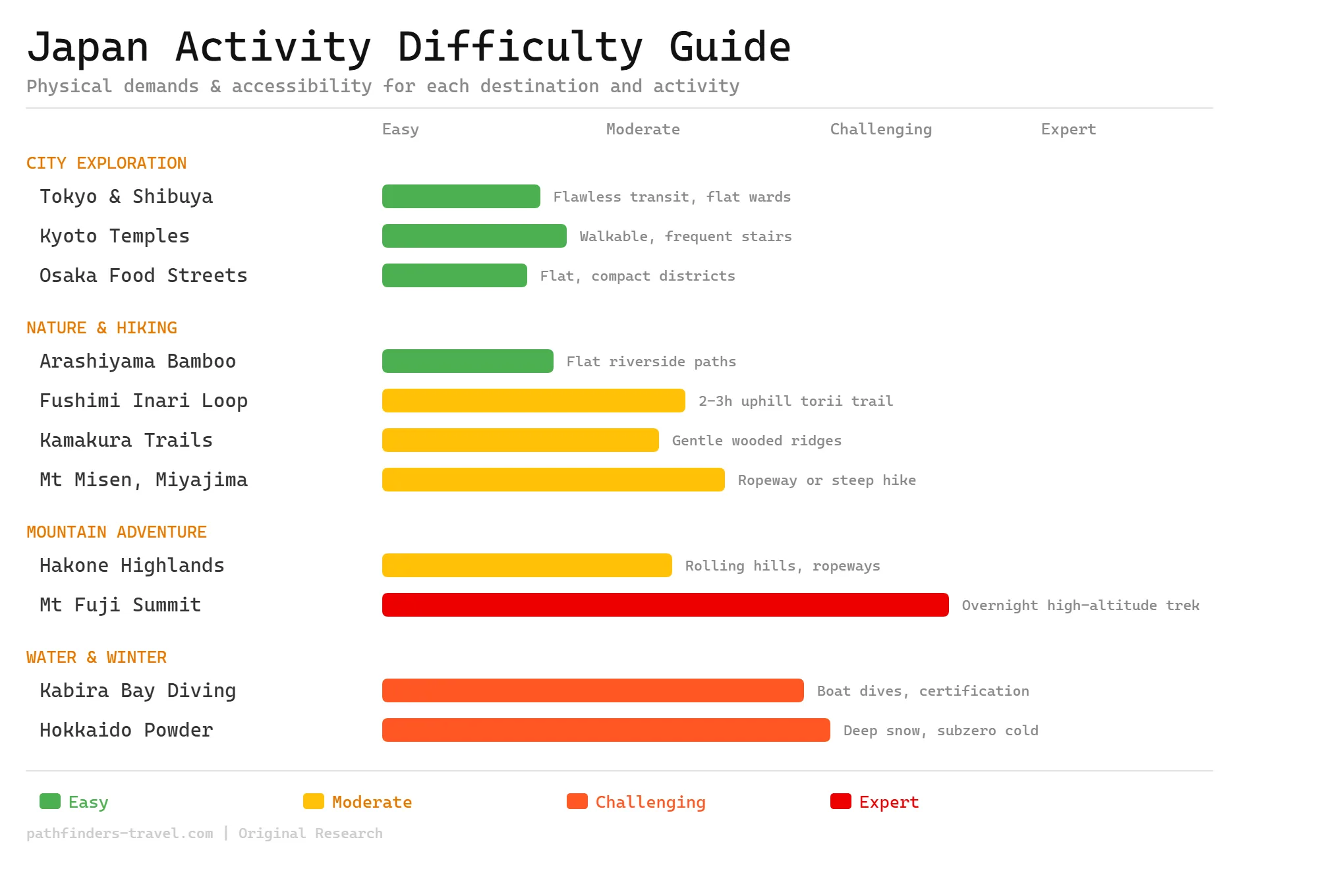
Japan offers experiences for every fitness level. The big cities are effortless thanks to flawless public transport, though expect plenty of walking and stairs at train stations and hillside temples. Sites like Fushimi Inari’s mountain loop, Kamakura’s hiking trails, and Miyajima’s Mount Misen require moderate fitness. The most demanding adventures are the overnight climb of Mount Fuji — a strenuous high-altitude trek during the official July–September season — and coral reef diving at Kabira Bay, where boat tours and certification courses cater to all levels. The chart below rates each destination and activity so you can plan according to your comfort level.
Transport
Transportation in Japan is world-class. The Shinkansen bullet train links Tokyo, Kyoto, Osaka, and Hiroshima at up to 320 km/h, and a Japan Rail Pass or regional passes make it affordable for multi-city trips. In cities, grab a rechargeable Suica or Pasmo IC card and tap through metros, buses, and even convenience stores. Domestic flights are the practical way to reach Hokkaido and Okinawa’s Ishigaki Island, while renting a car pays off in rural Hokkaido and around the Fuji Five Lakes in Yamanashi. I’d recommend using Google Maps or the Japan Travel by Navitime app for door-to-door transit routing.
Best Activities
The Best Activities & Tours That I Recommend
Blog Posts
No post found!