
GREEK ISLANDS TRAVEL GUIDE
Overview
The Greek Islands are the mountain peaks of a drowned continent — more than 6,000 islands and islets scattered across the Aegean and Ionian seas, of which around 227 are inhabited. You can wake up in a whitewashed Cycladic village, spend the afternoon walking a Minoan palace that predates the pyramids of Giza in their current form, and watch the sun drop into the sea from a harbour taverna the same evening. Few places in Europe pack this much history, coastline and food into one trip.
We love travelling here because the ferry network turns the whole archipelago into one long, flexible itinerary. Athens’ port of Piraeus is the natural gateway, with high-speed catamarans and slower car ferries fanning out to the Cyclades, the Dodecanese and Crete, while Corfu, Kefalonia and Zakynthos anchor the greener Ionian side in the west. Island-hopping is genuinely easy: you book a ferry, you show up, you go.
Santorini and Mykonos get the headlines, and they deserve a look, but the archipelago rewards anyone willing to go one ferry further. Naxos has the best beaches and the best mountain villages in the Cyclades. Milos hides more than 70 coves, including the lunar white rock of Sarakiniko. Crete is a country in miniature, with the Samaria Gorge, the pink sand of Elafonissi and a food culture all of its own. Karpathos, Ikaria, Symi and Amorgos still feel genuinely undiscovered in high season.
From the volcanic caldera of Santorini to the shipwreck cove of Zakynthos and the medieval walled town of Rhodes, the Greek Islands work as a first trip to Greece and as a tenth one. Whether you are here for hiking, archaeology, diving, or simply for grilled fish and a slow lunch by the water, you will find a version of these islands that fits.
Bookmark this Greek Islands travel guide and keep checking back for more of our best Greek island travel tips and hidden gems!
Country Snapshot
Safety
Greece is one of the safer countries in Europe, with low violent crime and a strong tourist-police presence on the busier islands. Petty theft and pickpocketing are the realistic risks, mostly in crowded ferry terminals, Athens metro stations and packed old towns. The bigger practical hazards are environmental: strong summer sun, the meltemi wind that can cancel ferries at short notice in July and August, unfenced cliff paths, and scooter accidents, which are by far the most common way visitors get hurt. The EU-wide emergency number is 112.
Greek is the official language, but English is widely spoken across the islands in hotels, tavernas and ferry offices, and signage is usually bilingual. Learning a handful of words — kalimera (good morning), efharisto (thank you), yassas (hello) — is genuinely appreciated, especially in mountain villages away from the ports.
Accommodation
Accommodation ranges from family-run domatia (simple guest rooms, often the best value on smaller islands) to boutique cave hotels carved into the Santorini caldera. Mykonos, Santorini and central Rhodes are the most expensive beds in the archipelago; Naxos, Paros, Kefalonia, Chios and Karpathos deliver similar coastline for a fraction of the price. Book Santorini, Mykonos and Milos several months ahead for July and August — the good rooms genuinely sell out — and remember that many island hotels close entirely between November and March.
Budget
The Greek Islands can be done on almost any budget. Hostel dorms and simple domatia run roughly €25–50 per night, mid-range hotels €70–150, and caldera-view suites in Oia climb well past €400 in peak season. A gyros costs around €4–5, a full taverna meal with wine €20–30 per person. Ferries are the other big line item: a high-speed Piraeus–Santorini crossing runs about €60–80, the slower conventional ferry roughly half that. Travelling in May, early June or late September cuts accommodation costs by 30–50% against August.
Best Time to Visit
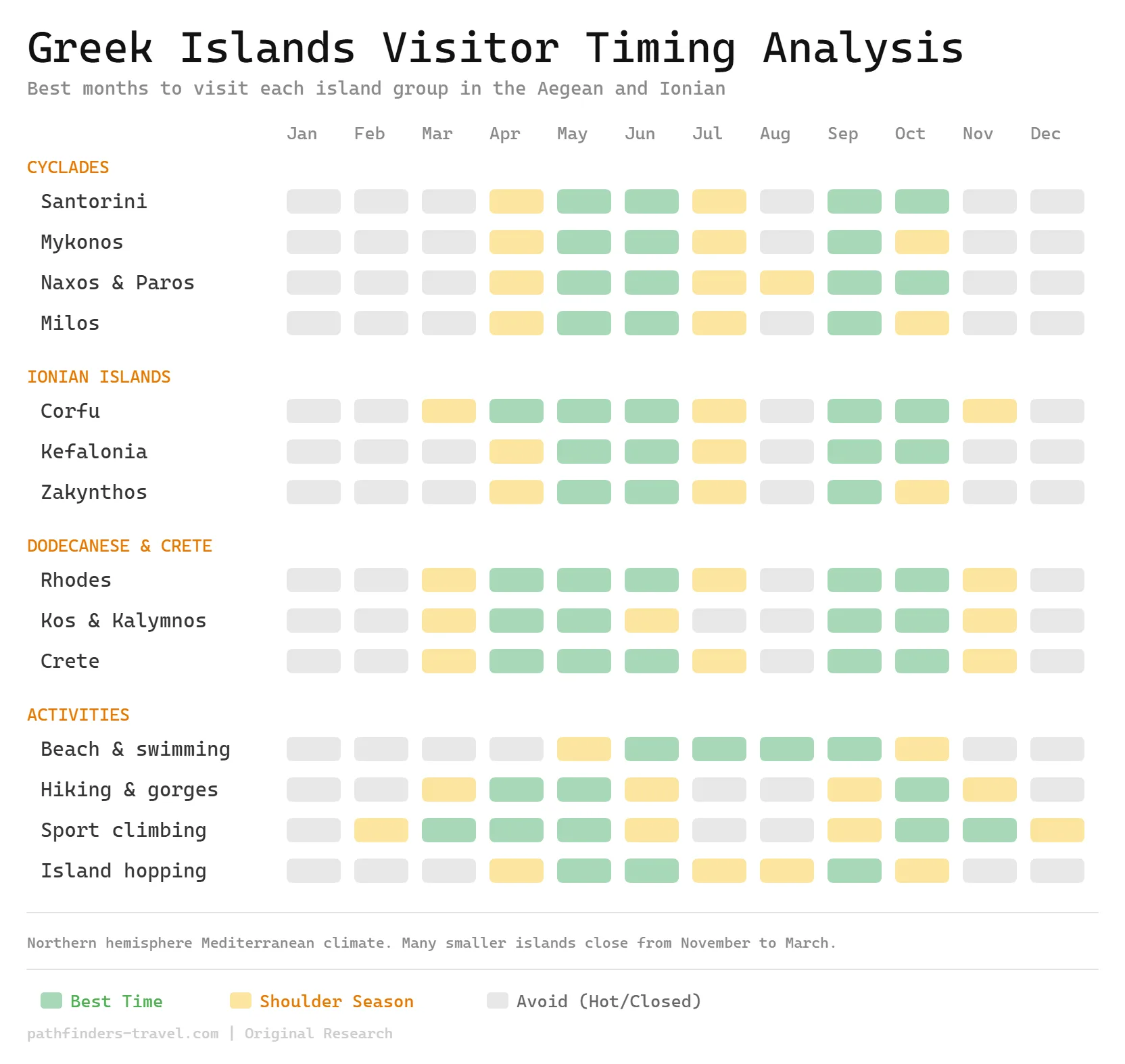
The Greek Islands have a Mediterranean climate — hot dry summers, mild wet winters — but the season matters more than the island. May to mid-June and September to mid-October are the sweet spot: sea temperatures are swimmable, the light is excellent, ferries run a full schedule and prices sit well below peak. July and August bring the most reliable heat and the busiest ports, plus the meltemi wind, which can gust hard through the Cyclades and occasionally cancels sailings. Crete and Rhodes hold their warmth longest and stay pleasant into late October. From November to March many smaller islands effectively close, though Crete, Rhodes and Corfu stay open year-round.
Places to Visit
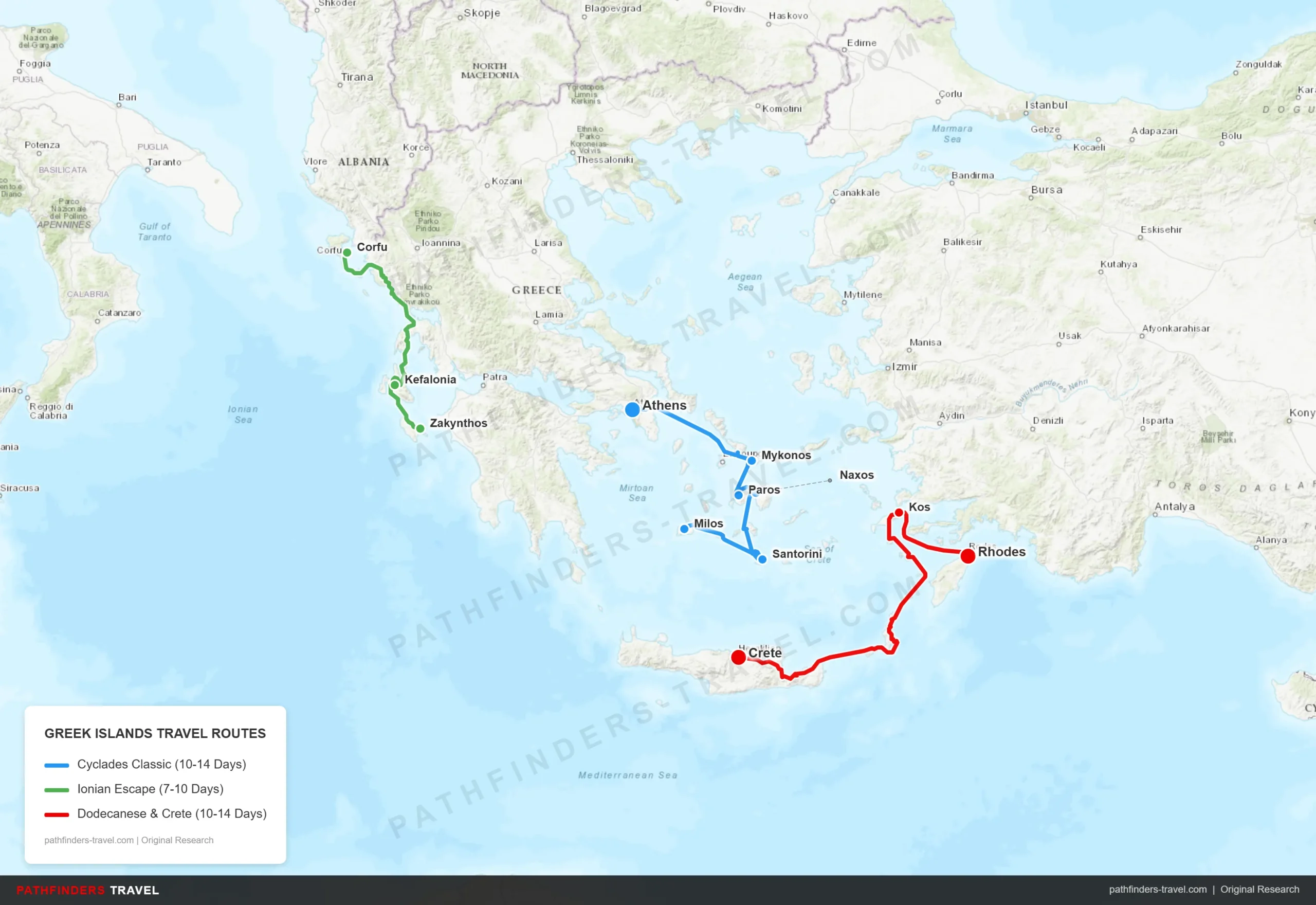
Because ferries, not roads, connect the archipelago, most travellers pick one island group per trip rather than trying to cross the whole Aegean. The Cyclades — Mykonos, Paros, Naxos, Santorini, Milos — are the classic first route, tightly linked by fast catamarans out of Piraeus. The Ionian islands in the west (Corfu, Lefkada, Kefalonia, Zakynthos) are greener, closer to Italy and easier to combine by short hops or even a road bridge. The Dodecanese, running down the Turkish coast from Rhodes to Kos and Kalymnos, pair medieval architecture with excellent climbing and diving, and connect naturally onward to Crete.
| # | Island | Highlights | Ferry Time |
|---|---|---|---|
| 1 | Athens (Piraeus) | Acropolis, Plaka, ferry gateway to the Aegean | — |
| 2 | Mykonos | Chora windmills, Little Venice, day trip to Delos | 2h 30m |
| 3 | Paros | Naoussa harbour, Lefkes village, kitesurfing at Golden Beach | 45m |
| 4 | Naxos | Portara gate, Mount Zas hike, Plaka and Agios Prokopios beaches | 30m |
| 5 | Santorini | Oia caldera sunset, Akrotiri excavations, Red Beach | 2h |
| 6 | Milos | Sarakiniko moonscape, Kleftiko sea caves, Plaka sunset | 1h 45m |
| # | Island | Highlights | Ferry Time |
|---|---|---|---|
| 1 | Corfu | Venetian Old Town, Achilleion Palace, Paleokastritsa coves | — |
| 2 | Lefkada | Porto Katsiki and Egremni beaches, reached by road bridge | 4h (road/ferry) |
| 3 | Kefalonia | Myrtos Beach, Melissani Cave, Assos village | 1h 15m |
| 4 | Zakynthos | Navagio Shipwreck Beach, Blue Caves, loggerhead turtles | 1h 30m |
| # | Island | Highlights | Ferry Time |
|---|---|---|---|
| 1 | Rhodes | Medieval walled Old Town, Lindos Acropolis, Prasonisi | — |
| 2 | Symi | Neoclassical Yialos harbour, Panormitis Monastery | 1h |
| 3 | Kos | Asklepieion ruins, Therma hot springs, flat cycling routes | 2h 30m |
| 4 | Kalymnos | World-class limestone sport climbing, sponge-diving heritage | 30m |
| 5 | Crete (Heraklion) | Knossos palace, Samaria Gorge, Elafonissi pink sand | 7h (overnight) |
Destination Difficulty
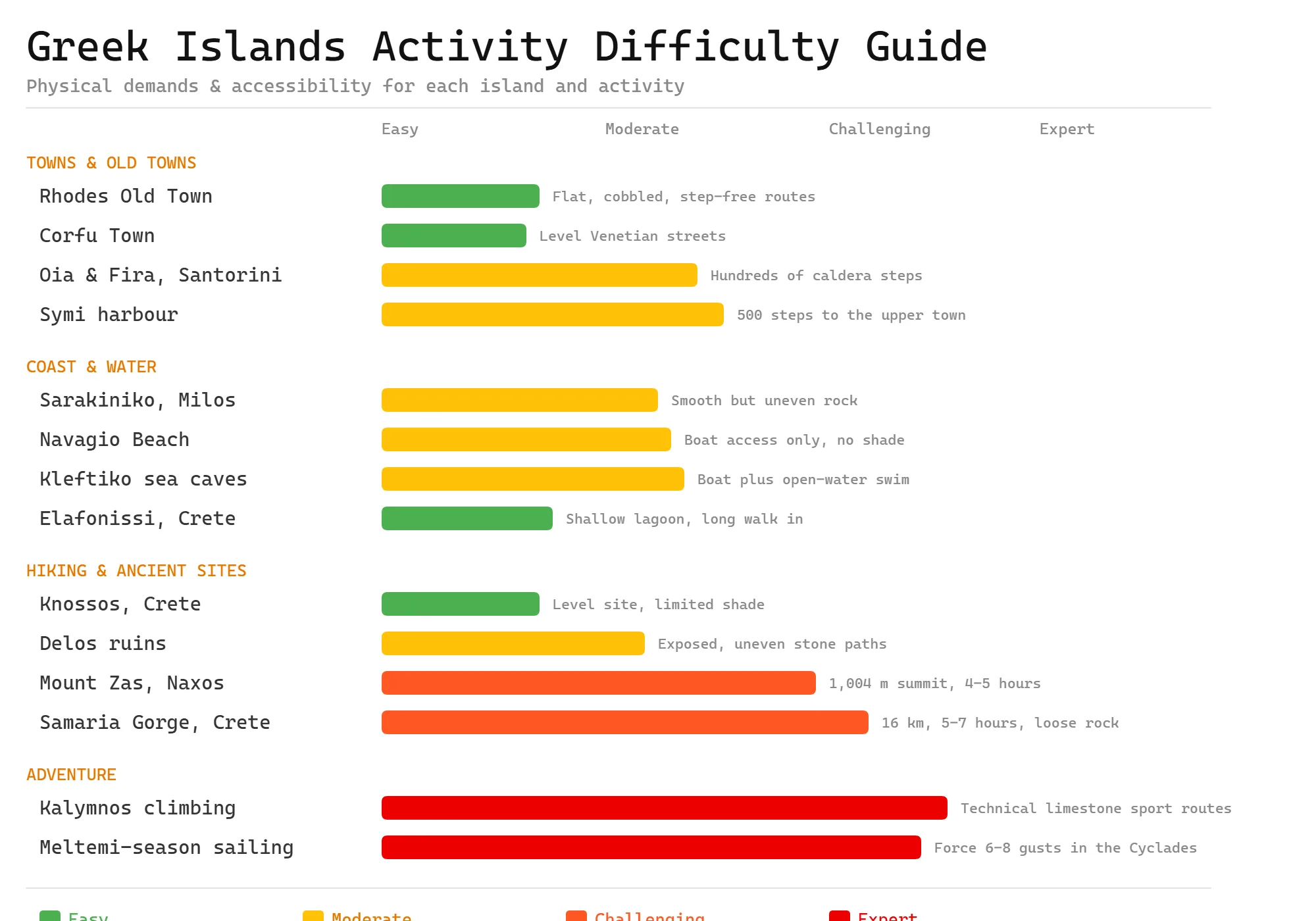
The islands span everything from step-free harbour promenades to serious mountain terrain. Old towns are the first surprise: Santorini’s Fira and Oia, Symi’s Yialos and much of Hydra are built on staircases, so accessibility is genuinely limited and cobbled lanes are hard work in the heat. At the easy end you have Rhodes Old Town, Corfu Town and most beach resorts, all essentially flat. In the middle sit the Sarakiniko rock formations on Milos, the ancient sites of Delos and Knossos, and the coastal paths of Paros and Naxos. The demanding end is real: the 16 km Samaria Gorge on Crete takes five to seven hours downhill on loose rock, Mount Zas on Naxos is a genuine 1,004 m summit hike, and the limestone sport-climbing on Kalymnos is world-class but technical.
Transport
Ferries are the backbone of Greek island travel. High-speed catamarans (Seajets, Golden Star) cover Piraeus to Mykonos or Santorini in roughly two to five hours; conventional ferries (Blue Star) are slower, cheaper, steadier in wind and take cars. Domestic flights from Athens serve Santorini, Mykonos, Rhodes, Crete, Corfu, Kos and several smaller islands in under an hour, which is worth it when your time is short. On the islands themselves, buses (KTEL) link the main towns and beaches cheaply but infrequently; a rental car makes sense on the big ones — Crete, Rhodes, Naxos, Kefalonia — while scooters and quads are popular but account for most visitor injuries, so wear a helmet and check your insurance covers them.
Best Activities
The Best Activities & Tours That I Recommend
Blog Posts
No post found!