
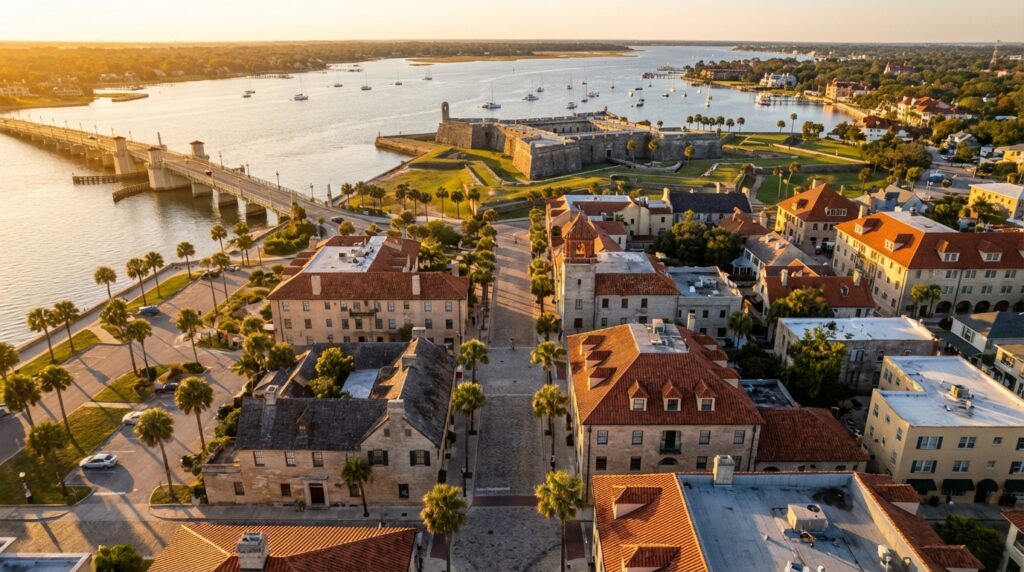
Estimated reading time: 11 minutes
Last updated: September 2026
What Is St. Augustine Known For?
St. Augustine is known as the oldest continuously occupied European settlement in the continental United States, founded by the Spanish in 1565. Its centerpiece is the 17th-century Castillo de San Marcos, a coquina-stone fort, surrounded by the cobblestone lanes of the historic district, Flagler-era architecture, ghost tours and nearby Atlantic beaches.
How We Researched This Guide
This guide was built from official St. Augustine tourism data, historical archives, 4K destination footage, and verified visitor reports. All details about attractions, hours, and costs were accurate when written. Please confirm current information with local sources before planning your visit.
Want to explore America’s oldest city from your screen? Watch our St. Augustine travel guide in 4K Ultra HD.
The Castillo de San Marcos sits on the waterfront like a blunt statement. Coquina stone walls three meters thick. Cannons aimed at Matanzas Bay. This fortress isn’t a replica. It’s the real thing, built between 1672 and 1695 by Spanish colonists who needed protection from British raids. According to the National Park Service, the Castillo de San Marcos National Monument draws over 700,000 visitors annually.
Spanish explorer Pedro Menéndez de Avilés planted a cross here in September 1565. That makes St. Augustine, Florida 42 years older than Jamestown and 55 years older than Plymouth Rock. The city of St. Augustine never emptied out. People have lived here continuously for 461 years.
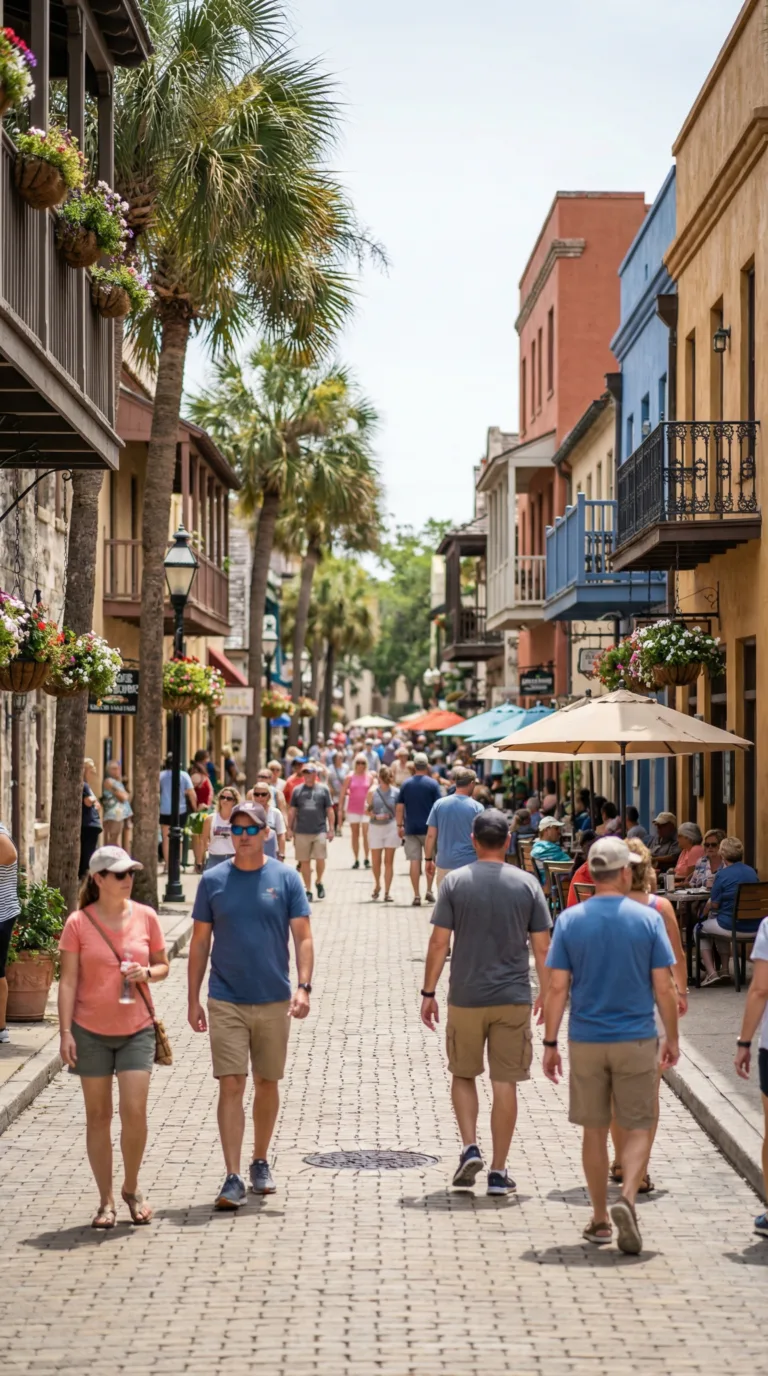
Walk the cobblestone streets of the historic district. Colonial Spanish architecture lines St. George Street. No cars allowed. Just pedestrians, horse-drawn carriages, and the occasional street musician. The buildings are low and thick-walled, painted in faded yellows and terracottas.
Beyond the fortress and the old town, St. Augustine offers 42 miles of Atlantic coastline. St. Augustine Beach sits 15 minutes east of downtown. The dining scene runs from seafood shacks serving peel-and-eat shrimp to farm-to-table restaurants in converted Spanish colonial homes. You can cover the main historic attractions on foot in two days. Most people stay three or four to hit the beaches and slow down. The Visit St. Augustine tourism board lists over 60 historic sites within city limits.
Top Attractions and Things to Do
St. Augustine’s top attractions include the 1672 Castillo de San Marcos fortress, Flagler College’s Spanish Renaissance architecture, Anastasia State Park’s 1,600-acre coastal preserve, and the annual Nights of Lights festival featuring over 3 million LED lights.
Planning Tip
Start at Castillo de San Marcos National Monument. Built in 1672, this Spanish fortress still stands because its builders used coquina stone, a local limestone made of compressed seashells. The walls absorbed British cannonballs instead of shattering. Rangers fire replica cannons twice daily on weekends. Climb to the gun deck. You’ll see Matanzas Bay and understand why Spain chose this spot to defend the harbor. Admission costs $15 per adult. Kids under 16 enter free.
Walk south to Flagler College. Henry Flagler built the Ponce de León Hall in 1888 as a luxury resort for Gilded Age millionaires. Today it’s a working college campus. The Spanish Renaissance architecture includes hand-painted murals by George Maynard and Tiffany stained glass windows. Flagler College offers public tours for $15. Across the street, the Lightner Museum occupies Flagler’s second hotel. The collection includes Victorian-era glass, furniture, and a basement full of mechanical musical instruments. Entry runs $20.
Head east to the beaches. St. Augustine Beach stretches four miles along A1A. The water stays calm most days. Surfers catch small breaks near the pier. Rent boards at shops on Anastasia Boulevard for $25 per day. North of the main beach, Anastasia State Park covers 1,600 acres with four miles of protected shoreline, according to Florida State Parks. The park charges $8 per vehicle. Trails wind through salt marshes and coastal hammocks. Bring binoculars for birdwatching.
The historic district runs on foot traffic. St. George Street closes to cars between the City Gate and the Plaza de la Constitución. Cobblestones replaced asphalt in the 1970s. Colonial buildings now house ice cream shops, art galleries, and restaurants. The street gets packed on weekends. Visit before 10 a.m. to walk without crowds.
Live music happens at the St. Augustine Amphitheatre. The 4,500-seat outdoor venue books national acts from May through October. Tickets range from $30 to $150 depending on the artist. Check the calendar before your trip.
From mid-November through January, the city runs Nights of Lights. Workers string over 3 million LED lights across buildings, trees, and bridges, per Visit St. Augustine. The display runs nightly from dusk until 10 p.m. King Street and the Plaza look best. Parking gets scarce after 6 p.m. Walk or take the trolley.
Families with kids should check the St. Augustine Aquarium on Anastasia Boulevard. Tanks hold local species like stingrays and sea turtles. A touch pool lets children handle horseshoe crabs. Admission costs $15.95 for adults, $10.95 for kids. The whole visit takes about a hour.
Ghost tours leave nightly from the old jail on San Marco Avenue. Guides tell stories about Spanish executions and British prisoners. Most tours cost $25 and last 90 minutes. Book ahead in October when paranormal enthusiasts fill the city. Historic home tours run daily at the Ximenez-Fatio House and the González-Alvarez House. Both charge $10 and show how residents lived in the 1700s and 1800s.
Waterfront activities cluster around the marina. Rent kayaks for $30 per hour to paddle through salt marshes. Fishing charters leave at sunrise for offshore trips. Expect to pay $400 for a half-day boat that holds four anglers. Dolphin-watching cruises run twice daily for $35 per person.
Where to Eat in St. Augustine
St. Augustine’s restaurant scene features over 200 dining establishments, from waterfront seafood houses serving local oysters to The Floridian’s farm-to-table Southern cuisine, concentrated along St. George Street and the historic bayfront.
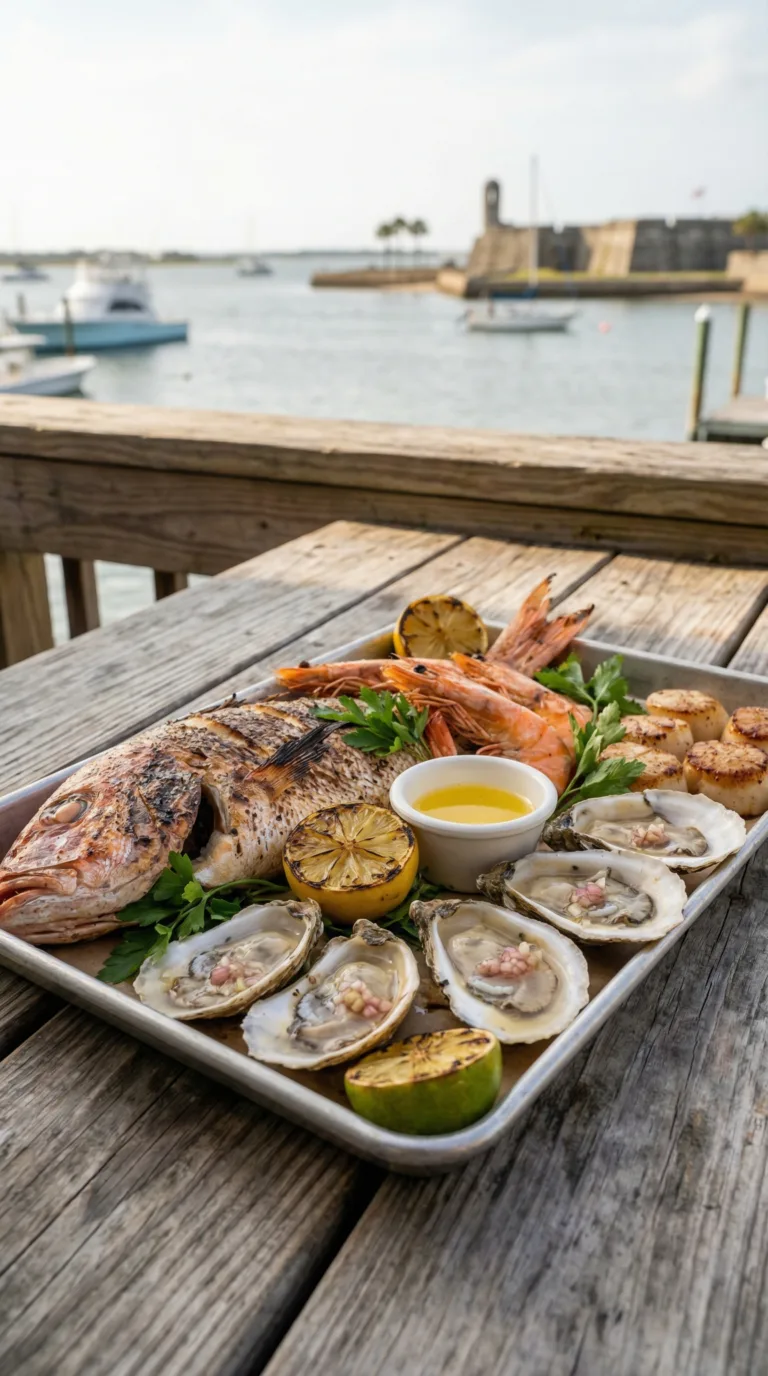
The city’s dining scene splits between two main zones. St. George Street packs cafes, ice cream shops, and casual spots into its pedestrian-only blocks. The bayfront and marina area delivers waterfront tables with views of Matanzas Bay. According to Visit St. Augustine, the historic district alone holds more than 200 restaurants, a density that rivals cities five times the size.
Seafood dominates most menus here. Raw bars serve Atlantic oysters on the half shell for $2–3 each. Grilled grouper, fried shrimp, and smoked mullet show up everywhere from dockside shacks to white-tablecloth rooms. Spanish and Mediterranean influences appear in paella dishes and tapas plates, echoes of the city’s colonial past.
The Floridian stands out for locals. This farm-to-table spot on Cordova Street sources ingredients from North Florida farms and serves Southern-style plates, shrimp and grits, fried green tomatoes, blackened catfish. Expect a wait on weekends. No reservations.
Budget eaters can hit diners along San Marco Avenue or grab Cuban sandwiches from corner bakeries for under $10. Upscale restaurants cluster near the Bridge of Lions, where dinner for two runs $80–120 with wine. The Visit St. Augustine official dining guide lists current menus and hours for the full range of options.
Where to Stay
St. Augustine offers approximately 6,000 hotel rooms ranging from boutique inns in restored 19th-century buildings within the historic district to beachfront resorts along St. Augustine Beach, with rates varying from $80-$400 per night depending on season.
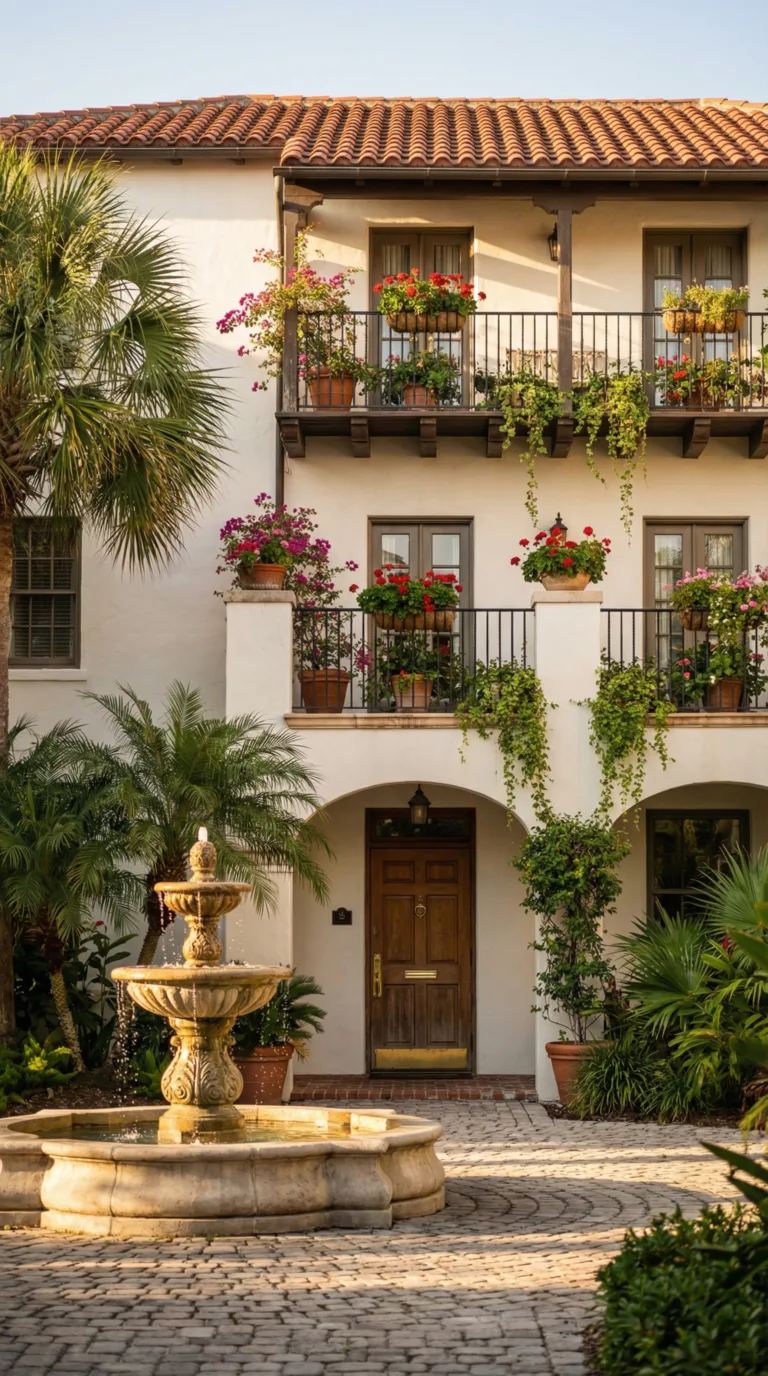
You’ve got three main zones. The historic district puts you within walking distance of Castillo de San Marcos, St. George Street, and the waterfront. Many hotels here occupy restored buildings with Spanish colonial details, stucco walls, terracotta roofs, interior courtyards. Expect to pay $150-$400 per night for these boutique properties. The trade-off: limited parking and higher prices.
St. Augustine Beach sits three miles east. Family-friendly resorts line A1A with direct beach access and pools. Rates run $120-$250 per night. You’ll need a car to reach downtown attractions, but the beach is steps away.
Budget motels cluster along US-1 and San Marco Avenue. Chains like Days Inn and Econo Lodge charge $80-$120 per night. You’re a 10-minute drive from the historic core.
Book early if you’re visiting March through August or during Nights of Lights (mid-November through January). According to the Visit St. Augustine official accommodation guide, occupancy rates exceed 85% during peak season. Hotels sell out weeks in advance for holiday weekends.
Location matters more than amenities. Staying in the historic district eliminates parking hassles and puts restaurants within a five-minute walk. Beach hotels work better for families prioritizing sand time over sightseeing. Mid-range chains on the outskirts save money but add 20-30 minutes of daily driving.
Day Trips from St. Augustine
St. Augustine’s location on Florida‘s northeast coast provides easy day trip access to Jacksonville 40 miles north, Daytona Beach 50 miles south, and Orlando’s theme parks 90 minutes west via Interstate 95 and Interstate 4.
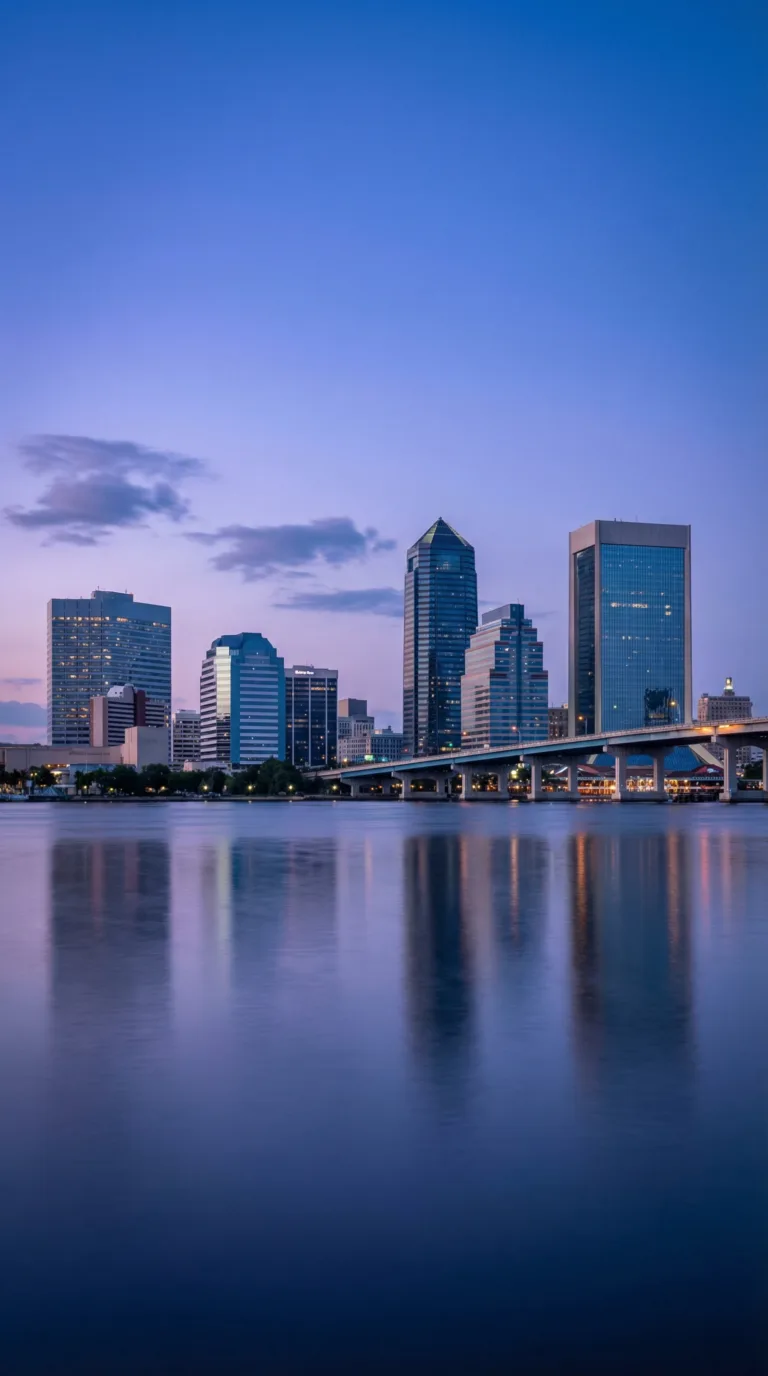
St. Augustine sits at the center of northeast Florida’s Atlantic corridor. You can reach three major cities within 90 minutes.
Jacksonville sprawls 40 miles north along I-95. The drive takes 45 minutes. The city’s riverfront downtown holds the Museum of Contemporary Art and the Cummer Museum of Art & Gardens. The Riverside and Avondale neighborhoods offer independent restaurants and breweries. Jacksonville Beach stretches 22 miles east of downtown. Check the Visit Jacksonville official tourism website for current museum hours and riverfront events.
Daytona Beach lies 50 miles south. You’ll drive through Marineland Dolphin Adventure, a small marine park that opened in 1938. Daytona’s hard-packed sand allows cars to drive directly onto the beach for a $20 daily fee. The Daytona International Speedway offers track tours year-round. The boardwalk holds arcade games and beachfront bars. Visit the Daytona Beach official tourism website for race schedules and beach access points.
Orlando sits 90 minutes west via I-95 and I-4. Walt Disney World, Universal Studios, and SeaWorld Orlando dominate the theme park corridor along International Drive. Traffic on I-4 backs up most afternoons. Leave St. Augustine by 7 a.m. to beat the crowds.
Cocoa Beach requires a two-hour drive south. The town serves as the closest beach to Kennedy Space Center Visitor Complex. Surfers hit the pier breaks year-round. Ron Jon Surf Shop operates 24 hours.
Tampa and St. Petersburg sit on the Gulf Coast, three hours west. The drive crosses the state on I-4. Busch Gardens Tampa Bay and the Salvador Dalí Museum in St. Petersburg justify the longer trip. Both cities offer different beach experiences than the Atlantic coast.
Miami and Miami Beach require four hours south on I-95. That’s too far for a comfortable day trip. Plan an overnight stay instead.
Frequently Asked Questions
Is St. Augustine expensive to visit?
St. Augustine is fairly affordable for a historic destination. Walking the old town and St. George Street is free, and individual attractions like Castillo de San Marcos (about $15) and the Lightner Museum are modestly priced. Hotels range widely, from roughly $80 a night at chains to $400 for historic boutique inns, with off-season and weekday stays offering the best value.
What are the best beaches in St. Augustine?
St. Augustine Beach is the main public beach with parking, restrooms, and the fishing pier. Anastasia State Park offers clean natural beach and protected dunes with a $8 vehicle entry fee. Vilano Beach to the north is quieter and less crowded than the main beach. All beaches feature Atlantic Ocean waves suitable for surfing and swimming. Water temperatures reach 80°F in summer but drop to 60°F in winter.
How many days do you need in St. Augustine?
2-3 days is ideal to see major attractions without rushing, according to Visit St. Augustine visitor surveys. One day can cover Castillo de San Marcos and the historic district if you start early. Add a second day for beaches and Anastasia State Park. A third day allows for day trips or deeper exploration of museums and tours. Most hotels offer better rates for multi-night stays.
When is the best time to visit St. Augustine?
March-May offers pleasant weather with highs in the 70s-80s and spring break energy downtown. September-November provides warm temperatures with fewer crowds after school starts. November-January features the Nights of Lights festival with millions of white lights covering the historic district. Summer (June-August) is hot, humid, and crowded but good for beach activities. Expect afternoon thunderstorms in July and August.
What events happen in St. Augustine?
Nights of Lights (November-January) is the signature event with over 3 million lights installed citywide. St. Augustine Amphitheatre hosts concerts year-round from national touring acts. Annual events include the Celtic Festival in March, Greek Festival in May, and Seafood Festival in April. Check the Visit St. Augustine events calendar for current happenings since dates shift yearly.