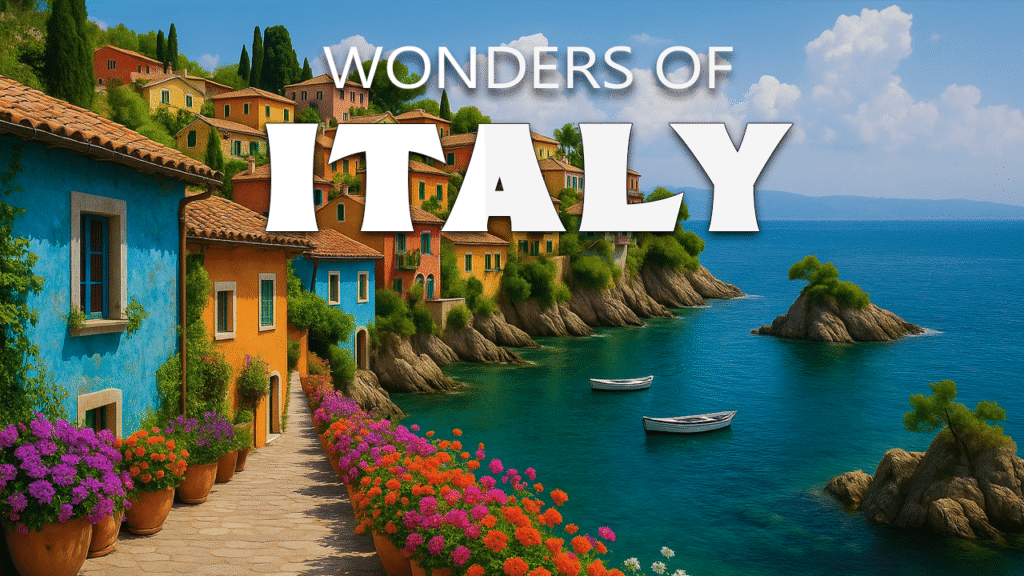
Three weeks of exploring famous Italian cities and tiny hill towns revealed something unexpected. The smaller places like Civita di Bagnoregio often outshone Rome. This guide covers both major cities and quieter coastal towns in Calabria, showing why Italy offers such varied experiences for travelers.
After exploring Italy in depth, I’ve created this guide to help you find the country’s most interesting places.
Watch the full travel documentary exploring Italy’s most interesting destinations:
Venice: The Floating City
Venice is beautiful, sure, but most locals have moved to the mainland because of the tourist crowds. What’s left? Mostly overpriced gelato shops. The Gothic palaces and Renaissance art are real, but you’ll see them while dodging selfie sticks and cruise ship groups. St. Mark’s Basilica is gorgeous, all gold mosaics and marble, but the €28 entrance fee and two-hour line make you question the value. The Doge’s Palace works better: you actually walk through rooms where they ran an empire, seeing the council chambers and secret passageways.
How This Guide Was Researched
This guide pulls from travel documentaries, verified tourism sources, and community traveler feedback. Prices and operational details were confirmed at the time of writing. Check official sources for the latest information before your trip.
The canals make Venice worth visiting. Budget a few hours watching gondolas glide under the Rialto Bridge and along quieter waterways. Each district (or sestiere) feels different. Dorsoduro has art students and cheap wine bars, while Cannaregio still has actual Venetians buying groceries at the morning market. Burano features colorful buildings, and the Grand Canal at sunset provides great photo opportunities, though you’ll compete with dozens of other photographers for space.
Visit in late March through May or October. Summer means sweaty crowds from cruise ships. The weather’s pleasant in spring and fall, and you’ll avoid the worst crowds. Explore at dawn if you want the city to yourself. It’s quieter and cooler then.
Verona: City of Romance
Verona’s just a hour from Venice. You’ll find that famous balcony from Romeo and Juliet here (even though Shakespeare never actually visited), plus a massive Roman arena standing in the middle of downtown. The ancient arena has stood for almost 2,000 years and still hosts an opera festival each summer. Tickets run €200+, which honestly feels steep when you’re sitting on 2,000-year-old stone bleachers without back support.
Walking through town, you’ll cross the Adige River on the old Ponte Pietra bridge, built from honey-colored stone now covered in moss where water splashes up. Piazza delle Erbe is perfect for people-watching over a €4 espresso. The Torre dei Lamberti looms over everything. Look up at the buildings and you’ll spot faded frescoes, barely visible now, but you can still make out saints and coats of arms from 500 years ago.
For the best views in Verona, climb to Castel San Pietro. The short hike’s totally worth it. You get this perfect view of all those terracotta rooftops and church spires with the Arena sitting right there, backed by mountains. June and September offer ideal weather for exploring or catching opera under the stars.
Madonna della Corona: The Cliffside Sanctuary
Just north of Verona, you’ll find one of Italy’s most dramatic sacred sites, Madonna della Corona. This sanctuary is built straight into a vertical cliff face, and honestly, when you first see it you’ll think someone’s joking, there’s no way a building should be hanging off a cliff like that.
Dating back to the 12th century, it began as a hermitage for monks seeking solitude. To reach this lesser-known spots, you must descend a winding path cut into the mountainside. With each step, more great views appear, building anticipation for the great church embedded in stone.
The Italian Lakes: Natural Splendor
Lake Garda
Italy’s largest lake straddles three regions, Lombardy, Veneto, and Trentino-Alto Adige, offering an amazing variety of landscapes. The northern part presents a fjord-like environment where dramatic mountains plunge into deep blue waters. Towns like Riva del Garda and Limone sul Garda nestle between towering cliffs and the lake’s edge.
As you move south, the lake widens and the terrain softens. The Sirmione peninsula extends into these southern waters, crowned by the 13th-century Scaliger Castle and home to ancient Roman ruins. Nearby, charming towns like Bardolino and Lazise offer medieval centers with colorful harbors.
Lake Garda’s unique microclimate supports olive groves, lemon trees, and vineyards alongside alpine flora. This environmental diversity makes it perfect for outdoor activities, from windsurfing to mountain biking. May to June or September provide ideal conditions for exploring without summer crowds.
Lake Como
Shaped like an upside-down “Y” and Set among the Alps, Lake Como has been a glamorous retreat since Roman times. Historic villas with immaculate botanical gardens dot its shores, with Villa Carlotta and Villa del Balbianello showcasing Renaissance and 18th-century beauty.
The lake’s calm blue waters create a beautiful backdrop for charming towns. Bellagio features cobbled lanes that wind uphill from the waterfront, while Varenna, with its colorful waterfront houses, offers a more relaxed atmosphere than its glamorous neighbors.
Turns out late spring to early summer and September offer the best conditions for experiencing Lake Como. Gardens are in bloom, temperatures are pleasant for boat trips, and you can dine alfresco beside the shimmering waters.
Lake Orta
Often overshadowed by its larger neighbors Como and Maggiore, Lake Orta offers a more intimate and calm experience. This small alpine lake became one of The best discoveries in northern Italy.
The centerpiece is the charming island of San Giulio, dominated by a 12th-century basilica and active Benedictine monastery. The island seems to float mysteriously on the lake’s calm surface, creating a spiritual atmosphere that has inspired contemplation for centuries.
The lakeside town of Orta San Giulio charmed me with its traffic-free medieval center, narrow cobblestone lanes, and elegant main square facing the water. Visit in late September to early October when summer crowds have departed, the lake waters remain warm, and surrounding forests display autumn colors.
Northern Italian Cities
Bergamo
Bergamo is really a city of two halves, the fortified Città Alta (Upper Town) on a hill and the modern Città Bassa (Lower Town) below. The Upper Town is encircled by impressive 16th-century Venetian walls, now a UNESCO World Heritage site.
Within these defenses lies a perfectly preserved medieval core where the elegant Piazza Vecchia forms the heart of civic life. Architect Le Corbusier once called it “the most perfect square in Europe”, and I have to agree.
The Lower Town offers elegant neoclassical avenues, leafy parks, and lively shopping districts. Connected to the Upper Town by a historic funicular, this more modern section showcases Bergamo’s evolution while maintaining its own distinct character and charm.
Milan
Milan blends historic beauty with contemporary innovation, creating a dynamic urban landscape unlike any other Italian city. The magnificent Duomo di Milano, one of the world’s largest Gothic cathedrals, dominates the city center with its forest of spires and statues.
Nearby, the elegant Galleria Vittorio Emanuele II arcade showcases 19th-century engineering and artistic brilliance beneath its spectacular glass dome. Milan balances historic treasures, like Leonardo’s Last Supper and the medieval Sforza Castle, with cutting-edge architecture like the Bosco Verticale (Vertical Forest) residential towers.
With the 2026 Winter Olympics approaching, Milan continues its evolution while maintaining its reputation for sophistication in fashion, design, and culinary innovation. April to June and September offer pleasant weather for enjoying outdoor cafés, rooftop views, and lively street life.
Turin
Turin, the elegant first capital of unified Italy, remains one of the country’s most underrated cities. Here, baroque beauty meets industrial heritage with recognizable northern flair.
The historic center showcases magnificent architecture from its royal past as the seat of the House of Savoy. Perfectly preserved baroque palaces line grand boulevards and spacious piazzas, while nearly 18 kilometers of arcaded walkways provide stylish shelter during shopping trips in any weather.
Beyond its elegant façades, Turin reveals a surprisingly diverse cultural scene. The city houses the world-renowned Egyptian Museum with collections second only to Cairo, the National Cinema Museum inside the iconic Mole Antonelliana tower, and numerous cafés where the Italian tradition of aperitivo reaches its highest expression.
Bologna
Bologna perfectly balances historical elegance with youthful energy. Often bypassed by travelers heading to Florence or Venice, this lesser-known spots offers an authentic taste of Italian life beyond the tourist trail.
The city’s most recognizable features are its nearly 40 kilometers of porticoes, elegant covered walkways that line the streets, providing shelter while framing views of Bologna’s red-hued medieval core. Above it all, the Two Towers (Due Torri) soar into the sky, with the leaning Asinelli Tower offering wide views for those willing to climb its 498 steps.
When The guide covers Bologna, Turns out authentic experiences at every turn, from morning espresso in centuries-old piazzas to evening aperitivo in lively university quarters. September to October proves ideal for visiting, when the weather remains pleasant for dining outdoors under the porticoes.
Trieste
Tucked between the Adriatic Sea and limestone karst plateau in Italy’s far northeastern corner, Trieste embodies a fascinating blend of Italian, Austrian, Slovenian, and Balkan influences. For centuries, it served as the Austro-Hungarian Empire’s primary maritime outlet, giving it a distinctly Central European atmosphere.
This unique heritage is visible in its neoclassical and Art Nouveau architecture, historic coffeehouses where writers like James Joyce once lingered, and the impressive Piazza Unità d’Italia, Italy’s largest sea-facing square.
The city’s dramatic setting offers beautiful coastal and urban vistas. From the waterfront promenade, you can admire the Adriatic extending toward the Istrian coast, while nearby Miramare Castle sits atop a rocky cliff overlooking the gulf. September and October provide ideal conditions when the summer bora winds have calmed.
The Magnificent Dolomites
These recognizable limestone peaks, a UNESCO World Heritage site, create a dramatic skyline unlike any other Alpine region. The Dolomites offer an extraordinary blend of Italian and Austrian heritage in South Tyrol. scenic alpine villages like Ortisei and Cortina d’Ampezzo showcase wooden chalet-style architecture, while local Ladin culture maintains ancient traditions and a unique language.
Every season transforms the Dolomites into a different natural masterpiece. Summer reveals thick green meadows carpeted with wildflowers beneath jagged peaks. Winter blankets the landscape in clean snow, creating a great destination for skiers. Fall brings a spectacular display as larch trees turn golden against the pale limestone mountains.
The Dolomites’ iconic landmarks include the towering Tre Cime di Lavaredo pinnacles and the green Alpe di Siusi plateau. July and September offer ideal conditions for experiencing the mountains’ beauty while avoiding August crowds.
Central Italy’s Treasures
Florence
The cradle of the Renaissance continues to charm visitors with its outstanding concentration of artistic masterpieces and architectural wonders. The city’s skyline is dominated by Brunelleschi’s ingenious terracotta-tiled dome crowning the Duomo, an engineering marvel completed in 1436.
Florence showcases the world’s greatest collection of Renaissance art. Masterpieces by Michelangelo, Leonardo, Botticelli, and countless others adorn the Uffizi Gallery, while Michelangelo’s David stands in perfect marble splendor at the Accademia.
For the best experience, Don’t miss Florence in May or September. These months offer pleasant weather for strolling across the Ponte Vecchio or climbing to Piazzale Michelangelo for wide views, while avoiding the intense summer heat and crowds.
Val d’Orcia
Traveling south from Florence, you’ll find the quintessential Tuscan landscape, Val d’Orcia, a lesser-known spots preserved as a UNESCO World Heritage cultural landscape. Here, gentle hills roll toward the horizon in perfect balance with human activity, creating scenes that seem plucked from a masterpiece.
Medieval towns like Pienza (a Renaissance “ideal city” designed by Pope Pius II), Montepulciano, and Montalcino crown hilltops above a carefully cultivated countryside. The lone Romanesque abbey of Sant’Antimo and the fortress of Rocca d’Orcia stand as timeless landmarks across this living canvas.
Few landscapes are as instantly recognizable as Val d’Orcia’s rolling hills with cypress-lined roads. Late April to early July or September to October offer the best conditions to experience this timeless rural landscape that embodies the essence of Tuscany.
Umbria
While neighboring Tuscany draws the crowds, Umbria, “Italy’s green heart”, offers equally beautiful hilltop towns and artistic treasures with far fewer tourists. Perugia, the region’s proud capital, rises dramatically from the valley on a commanding hilltop. Its historic center showcases multiple eras, Etruscan walls, medieval towers, Gothic palaces, and Renaissance masterpieces.
The magnificent Piazza IV Novembre forms the heart of the city, with its ornate Fontana Maggiore and imposing Palazzo dei Priori reflecting centuries of civic pride. Beyond its architectural splendor, Perugia maintains a lively cultural atmosphere thanks to its prestigious university and international arts festivals.
Rome
The Eternal City layers over 2,500 years of continuous history into an open-air museum that defines Italian culture. Rome’s ancient wonders stand as testaments to imperial ambition. The Colosseum remains the city’s iconic symbol, while the Roman Forum’s temples and basilicas reveal daily life in the empire’s center. The Pantheon’s perfect dome demonstrates Roman engineering genius that remains unsurpassed even today.
Vatican City presents another dimension of Rome’s beauty. St. Peter’s Basilica crowned by Michelangelo’s magnificent dome, the Vatican Museums housing countless masterpieces, and the transcendent beauty of the Sistine Chapel ceiling represent the pinnacle of Renaissance artistic achievement.
Beyond these iconic sites, Rome reveals its charm in neighborhood piazzas where locals gather, in hidden churches housing unexpected artistic treasures, and along cobblestone streets where ancient ruins stand alongside lively cafes. The Holy Year Jubilee 2025 will draw millions of pilgrims and visitors, making spring and fall the ideal times to experience Rome without peak summer crowds.
Coastal Gems
Cinque Terre
The five colorful fishing villages of Cinque Terre, Monterosso, Vernazza, Corniglia, Manarola, and Riomaggiore, cling dramatically to steep cliffs above the Mediterranean. These UNESCO-protected villages have maintained their distinct character despite growing popularity. Connected by scenic hiking trails and a coastal railway rather than roads, Cinque Terre offers a unique car-free environment.
Each village has its own personality. Vernazza has a small harbor and castle. Manarola has houses built along the cliffs. Riomaggiore has narrow buildings rising from a small cove. Corniglia sits high on a cliff. Monterosso has a longer beach and a resort feel. Together, they create what many consider the most scenic stretch of coastline in Italy.
Mid-September to October or mid-April to May provide the best balance for visiting Cinque Terre. During these shoulder seasons, the summer crowds have dispersed, hiking conditions are excellent, and you can enjoy the villages at a relaxed pace.
Campania Region
The lively Campania region offers some of Italy’s most dramatic coastal scenery. The Amalfi Coast captivates with its impossible beauty, sheer limestone cliffs plunging into turquoise waters, with pastel-colored villages like Positano and Amalfi cascading down the mountainsides. Once a powerful maritime republic, Amalfi town showcases its historical importance through its impressive cathedral, while Positano’s vertiginous layout of colorful homes embodies Mediterranean glamour.
Just around the corner of the peninsula lies Naples, Italy’s third-largest city and its most lively urban center. Beneath the watchful gaze of Mount Vesuvius, Naples pulses with authentic energy, where narrow streets reveal Baroque churches, underground Roman ruins, and the world’s finest pizza.
Ischia is another great spot in the region. It’s called the “green island” in the Bay of Naples. Long beloved by Italians but often overlooked by international travelers, Ischia offers thermal hot springs that have attracted wellness seekers since ancient times. Late May to June or September offers ideal conditions for exploring all three destinations.
Puglia
Once overlooked by international travelers, sun-drenched Puglia has emerged as one of Italy’s trending hotspots. The region’s most iconic sight is undoubtedly the trulli of Alberobello, curious conical-roofed limestone dwellings found nowhere else in the world. These prehistoric-looking structures create a fairytale landscape as they cluster together in entire neighborhoods.
The region’s coastline offers dramatic contrasts, from the vertiginous cliffs of Polignano a Mare, where white buildings perch precariously above the electric-blue Adriatic, to long stretches of sandy beaches rivaling the Caribbean.
Gleaming white hill towns like Ostuni rise from the landscape like visions from another time. Nicknamed “The White City,” Ostuni’s maze of whitewashed buildings, narrow alleys, and ornate churches creates a beautiful contrast against the blue sky. May to June or September provides ideal conditions to experience Puglia’s charms.
Southern Italy’s Hidden Wonders
Matera
This great city represents one of the most dramatic transformations in Italy’s tourism landscape, evolving from “the shame of Italy” to a celebrated UNESCO World Heritage site and European Capital of Culture. What makes Matera unique is its ancient cave dwellings, the Sassi di Matera, a labyrinth of stone houses and churches literally carved into the ravine.
These prehistoric habitations are believed to be among the oldest continuously inhabited settlements in the world, with evidence of occupation dating back to Paleolithic times. The city unfolds like a living nativity scene across two districts, Sasso Caveoso and Sasso Barisano, with cave dwellings stacked one above another.
Since being designated a UNESCO site and European Capital of Culture, Matera has transformed abandoned cave dwellings into boutique hotels, restaurants, and artisan workshops, while maintaining its authentic spirit. Visit during spring or fall to experience comfortable temperatures for exploring the maze-like streets.
Sicily
Italy’s largest island combines Greek temples, Norman cathedrals, volcanic landscapes, and some of Italy’s most beautiful beaches into one memorable trips. On Sicily’s eastern coast, Taormina has been drawing visitors since the Grand Tour era with its perfect combination of natural beauty and cultural riches. Perched on a hillside overlooking the Ionian Sea, its ancient Greek Theater frames postcard-perfect views of the coastline with Mount Etna creating a dramatic backdrop.
In the southwest, the Valley of the Temples near Agrigento presents one of the world’s most great archaeological sites. This UNESCO-listed ridge showcases magnificent Greek temples dating from the 5th century BC, including the exceptionally well-preserved Temple of Concordia.
Syracuse’s island district of Ortigia concentrates Sicily’s layered history into a charming peninsula. Here, narrow medieval streets lead to Baroque piazzas, ancient Greek ruins sit beneath Norman churches, and the magnificent Cathedral incorporated a 5th-century BC Temple of Athena into its structure. May to June and September to October offer ideal conditions for exploring Sicily’s treasures.
Beyond the Familiar Path
The wonders of Italy extend far beyond the destinations I’ve covered. This great country offers countless treasures waiting to be discovered by curious travelers willing to venture beyond the familiar paths.
In northeastern Italy, the border city of Gorizia shares the title of European Capital of Culture 2025 with its Slovenian neighbor Nova Gorica, offering visitors a fascinating blend of Italian, Slavic, and Austrian influences. Nearby, Ravenna dazzles with the world’s finest Byzantine mosaics outside Istanbul, their gold tesserae still glowing brilliantly after 1,500 years.
The Renaissance perfection of Urbino in Le Marche, birthplace of Raphael, and the seemingly impossible clifftop village of Civita di Bagnoregio in Lazio, aptly nicknamed “the dying city” as it slowly erodes away, represent Italian gems that reward travelers seeking authenticity without crowds.
Along the Ligurian coast, colorful fishing villages like Camogli offer the coastal charm of Cinque Terre without the crowds, while further south, Calabria’s dramatic coastline at Tropea and Scilla remains Italy’s last untamed shore. Finally, Sardinia beckons with the jet-set allure of Costa Smeralda’s turquoise waters and the Catalan-influenced coastal town of Alghero.
With Alpine peaks and Mediterranean shores, Italy’s timeless beauty continues to charm travelers who take the time to find its treasures. The true magic of Italy lies in exploring beyond the famous destinations. Visit in spring or fall for the best experience, and remember that each region offers its own distinct character and charm.