Estimated reading time: 7 minutes
Table of Contents
- Introduction
- Exploring Trondheim’s Historic Charms
- Nidaros Cathedral Trondheim
- Trondheim Old Town Bridge
- Bakklandet District Trondheim
- Things to Do in Trondheim
- Conclusion
Introduction
In the heart of central Norway, where the Nidelva River flows into the Trondheim Fjord, stands a city that embodies over a thousand years of Norwegian history. Trondheim, founded in 997 by Viking King Olav Tryggvason, represents a living testament to Norway’s evolution with medieval kingdom and modern nation.
As Norway’s first capital and the traditional site of royal coronations, Trondheim holds a special place in the nation’s cultural and spiritual heritage. The city’s medieval Nidaros Cathedral is the northernmost Gothic cathedral in the world, while charming districts like Bakklandet showcase perfectly preserved wooden architecture that tells stories of centuries past.
Today, Trondheim pulses with the energy of a lively university city, home to the Norwegian University of Science and Technology (NTNU). This unique blend of ancient heritage and youthful innovation creates an atmosphere where historical significance meets contemporary culture, making it an essential destination for travelers seeking to understand the depth and complexity of Norwegian identity.
Historic districts, or the dynamic cultural scene, Trondheim offers experiences that reveal how Norway’s past continues to shape its present, creating a destination that rewards both casual visitors and serious students of history and culture.
You can see this for yourself. Click here to watch the video from this point.
Exploring Trondheim’s Historic Charms
Overview of Trondheim
Founded in 997 by Viking King Olav Tryggvason, Trondheim is one of Norway’s oldest cities and its first capital. Today, this lively city offers visitors a compelling mix of historical significance and contemporary energy, making it a fascinating destination for those seeking things to do in Trondheim.
Set the banks of the Nidelva River where it flows into the Trondheim Fjord, the city enjoys a scenic setting that complements its architectural treasures. Unlike many modern cities, Trondheim has maintained its historical street layout and preserved numerous wooden buildings, creating an atmosphere that connects visitors to Norway’s past.
As home to the Norwegian University of Science and Technology (NTNU), Trondheim pulses with student life, bringing youthful energy to its ancient streets. This blend of venerable history and contemporary culture creates a recognizable character that sets Trondheim apart from other Norwegian destinations. Many travelers exploring Norway’s travel itineraries find Trondheim to be an essential stop that provides deep insights into the nation’s heritage.
Nidaros Cathedral Trondheim

By Knut Arne Gjertsen, Eigenes Werk, CC BY-SA 3.0, Link
The magnificent Nidaros Cathedral Trondheim is the northernmost Gothic cathedral in the world and Norway’s most important religious building. Construction began in 1070 over the burial site of St. Olav (King Olav II), who brought Christianity to Norway and later became the country’s patron saint.
This architectural masterpiece took over 230 years to complete, with construction continuing until approximately 1300. The cathedral’s western façade features an intricate array of sculptures depicting biblical scenes and saints, creating what many consider Norway’s greatest medieval artistic achievement.
The cathedral’s impressive features include:
- The west front with its elaborate stone carvings and magnificent rose window
- The octagonal choir, which houses the shrine of St. Olav
- Beautiful stained glass windows, many dating from the early 20th century restoration
- The Chapter House, featuring great acoustics
- The Crown Regalia exhibition in the adjacent Archbishop’s Palace
As Norway’s traditional coronation church, Nidaros Cathedral has witnessed the crowning of Norwegian monarchs for centuries. Today, it continues to serve as both an active place of worship and a major pilgrimage site. The cathedral hosts regular concerts that showcase its exceptional acoustics, allowing visitors to experience the building’s splendor through music.
For the most complete experience, visitors should consider climbing the tower for wide views of Trondheim or exploring the archaeological excavations beneath the cathedral that reveal its complex construction history.
Trondheim Old Town Bridge

By Elizabeth B. Thomsen
The Trondheim Old Town Bridge (Gamle Bybro) spans the Nidelva River, connecting the city center with the charming Bakklandet district. Built in 1861, this recognizable red bridge has become one of Trondheim’s most photographed landmarks and an essential part of the city’s identity.
Often called the “Portal of Happiness” or “Gate of Happiness,” the bridge features two classical gateway portals at either end. These ornamental structures were designed not just for aesthetic purposes but as symbolic gateways welcoming travelers into the heart of the city.
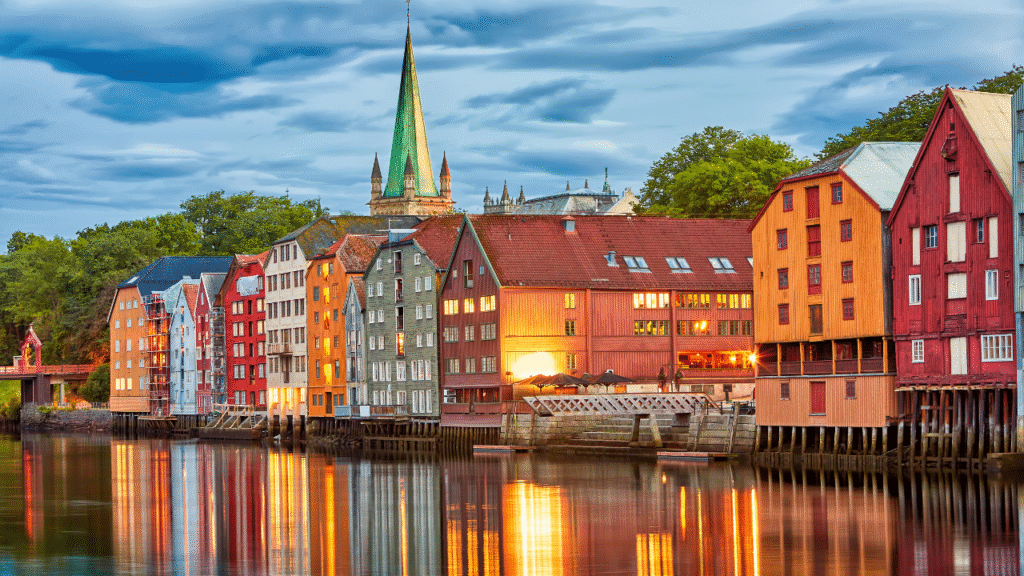
From the bridge, visitors enjoy spectacular views of the colorful wooden warehouses that line the river. These historic buildings, painted in bright reds, yellows, and ochres, were once used by merchants to store goods and now house apartments, restaurants, and shops. Their reflections in the calm waters of the Nidelva create scenic scenes that capture Trondheim’s special character.
The Old Town Bridge serves as crossing point, it’s a social space where locals and visitors alike gather to enjoy the scenery, especially during summer evenings when the light lingers late into the night. Street musicians often perform on or near the bridge, adding to its lively atmosphere.
For the best experience, visit the bridge at different times of day to see how changing light transforms the view of the warehouses and the river. Early morning offers peaceful solitude, while sunset bathes the scene in golden light that highlights the buildings’ lively colors.
Bakklandet District Trondheim

By Leonhard Lenz
Crossing the Old Town Bridge leads directly to the Bakklandet district Trondheim, a neighborhood that captures the essence of old Norway with its narrow cobblestone streets and beautifully preserved wooden houses. Once a working-class area housing laborers and craftspeople, Bakklandet has transformed into one of the city’s most charming and lively districts.
The district’s wooden buildings, many dating from the 18th and 19th centuries, have been lovingly restored and painted in traditional bright colors. Their wooden facades create a warm, inviting atmosphere that contrasts with the more formal stone buildings of the city center. Many structures feature traditional details like decorative woodwork and small gardens that add to their charm.
Bakklandet has emerged as Trondheim’s culinary and café heart, with numerous establishments occupying historic buildings. The most famous is Kafé Bakklandet, housed in a tiny wooden structure and known for its homemade cakes and cozy atmosphere. Throughout the district, you’ll find everything from traditional Norwegian eateries to international cuisine, often served in uniquely atmospheric settings.
The district is famously bicycle-friendly, even featuring the world’s first (and possibly only) bicycle lift called “Trampe,” which helps cyclists get around the steep hill leading up from the river. This modern solution reflects the neighborhood’s blend of historical charm and forward-thinking practicality.
Shopping in Bakklandet focuses on independent boutiques selling handcrafted items, vintage goods, and locally designed products. The emphasis is on quality and uniqueness rather than mass-produced souvenirs, making it an ideal place to find authentic mementos of your visit to Norway.
Things to Do in Trondheim
Beyond its most famous landmarks, Trondheim offers visitors a wealth of activities and attractions that showcase the city’s blend of historical significance and contemporary vitality. Here are additional things to do in Trondheim that will enhance your understanding of this fascinating Norwegian city:
The Ringve Music Museum, Norway’s national museum of music and musical instruments, is housed in a historic manor with beautiful botanical gardens. The museum’s interactive exhibits allow visitors to experience instruments from around the world, while guided tours often include musical demonstrations.
Kristiansten Fortress, built in the 17th century, stands on a hill east of the city center and provides excellent views over Trondheim. The fortress played a crucial role in protecting the city and today serves as both a historical monument and a popular recreational area for locals and visitors.
The Trøndelag Folk Museum, one of Norway’s largest open-air museums, features over 80 historical buildings arranged to show how Norwegians lived from the Middle Ages to the present day. The museum brings history to life through demonstrations of traditional crafts, especially during summer months and holiday seasons.
For those interested in science and technology, the Rockheim national museum of popular music offers interactive exhibits chronicling Norway’s music history, while the Trondheim Science Center provides hands-on experiences with scientific principles suitable for visitors of all ages.
Trondheim’s food scene deserves exploration beyond Bakklandet. The city’s location near both sea and agricultural lands make sures fresh ingredients for its restaurants. The Trondheim Food Hall (Mathallen) showcases local products and offers dining options ranging from traditional Norwegian fare to international cuisine. Understanding Norway’s travel costs can help you budget for these culinary experiences.
The Munkholmen Island, a short boat ride from the city center, has served various purposes throughout history, monastery, prison, fortress, and now recreational area. Summer boat services make this an easy half-day excursion from the city.
Seasonal activities add to Trondheim’s appeal. Winter visitors can enjoy nearby skiing facilities, while summer brings outdoor concerts, festivals, and the opportunity to experience the long northern days when daylight extends well into the evening hours.